


VirtualDJ is quite the conundrum in the DJ software world. It’s been around since the dawn of digital DJing, and has all the features and then some needed by more or less every style of DJ. It really does — you should look at the feature list and dig around inside the preferences to see the power. And the user base is massive, if you give the numbers pushed out by owners Atomix as being a real representation of the true number of active users that is.
But despite all of this, the VirtualDJ brand is perceived poorly in comparison to the pro trinity of Traktor Pro, Serato DJ Pro, and rekordbox. I’m sure I could write reams of words dissecting the reasons for this, but it’s a thing and is something that Atomix is addressing directly in the release of VirtualDJ 2020.

To be clear — I’m running the beta version of the VirtualDJ 2020 download. But the application is still called VirtualDJ 8, and the preferences show that this is v8.4 b5308. I don’t know if this will change in the final release, but it does reflect the vibe I got from Atomix regarding this release. For them, 2020 is a fresh way of thinking about VirtualDJ and where it sits in the somewhat volatile DJ software landscape.
So It’s not a rebuild or some form of reimagining — it’s still the VirtualDJ that oh so many have come to know and love, but with perhaps a different approach to the DJ community. They also talk of not holding back big features for landmark releases too. If a feature is ready, it gets added.

THE BIG CHANGE
It’s all about the interface. VirtualDJ is unusual in the pack of major players in that it has a skinning engine. This means that you can tweak the interface into anything from a minimalist barren landscape, right up to a truly headache inducing graphical nightmare. But I suspect that most people draw their conclusions from the first impressions of opening VirtualDJ for the first time.
Firstly, there’s a new approach to the DJ community, with default skins being tailored to where you see yourself and skill level as a DJ. A dropdown menu offers the following:
STARTER: Stripped back with an instant gratification vibe.
ESSENTIALS: You’ve got the basic down — now it’s time to step up. This layout delivers the main features you’ll find on controllers.
PRO: The new flatter VirtualDJ 2020 becomes apparent, with more advanced control (including custom buttons) over effects and what you see in the players. Think full fat decks.
PERFORMANCE: This pulls back the plethora of available features in the decks a tad, and gives more of the screen over to the library.
I like this as it’s almost a training wheels approach, where you can progress through the VirtualDJ experience without the fully daunting bells and whistles approach.
Given that this is a beta, there are a few wrinkles to iron out though. For example, there’s no real 4 deck view by default. You have to go to the Pro skin, and from the options dropdown select 4 decks. Then you get more options on 4 decks. But there’s no four deck view in performance mode unless you select in pro mode first. And vertical waveforms only appear in performance mode, but stay when you switch to pro mode. Odd.
This is obviously new territory for VirtualDJ 2020, and I’m sure these small issues will be ironed out soon enough.

THE OLD

THE NEW
VISUALLY MATURE
I’m not about to trawl through old screenshots to show every iteration of the evolution of the default VirtualDJ interface. But needless to say that it has changed considerably over the years. VirtualDJ 2020 is a natural progression from the last default interface — it’s flatter for a start, with the skeuomorphic shaded buttons finally being ditched. The red/blue deck 1 and 2 metaphor is more subtle too. It’s generally more subdued, and reminiscent what might happen if you put Algoriddim djay and Traktor Pro in an interface blender.

Inside each level there’s also an abundance of options within these new default skins too. VirtualDJ 2020 offers full control over just about anything you could hope for. Well… once you’re out out of starter mode that is. But you can change colour scheme (shades of grey and even a daylight mode), waveform appearance, jogwheel display etc etc — it’s all there.
One unrelated thing to point out — the preferences are insane. Under “options and tweaks” you get a ridiculous amount of control over what VirtualDJ does. And because there’s just so much, there’s a search box to help you find things that it may be able to do.
For me and painting a broad stroke, it feels better and definitely more elegant and professional. You can of course still use last week’s default in “old” mode, or load in whatever unpleasant retina scorching skin you have used for the last decade. Choice is good, and VirtualDJ 2020 offers a huge amount without over-facing.
MORE STREAMING
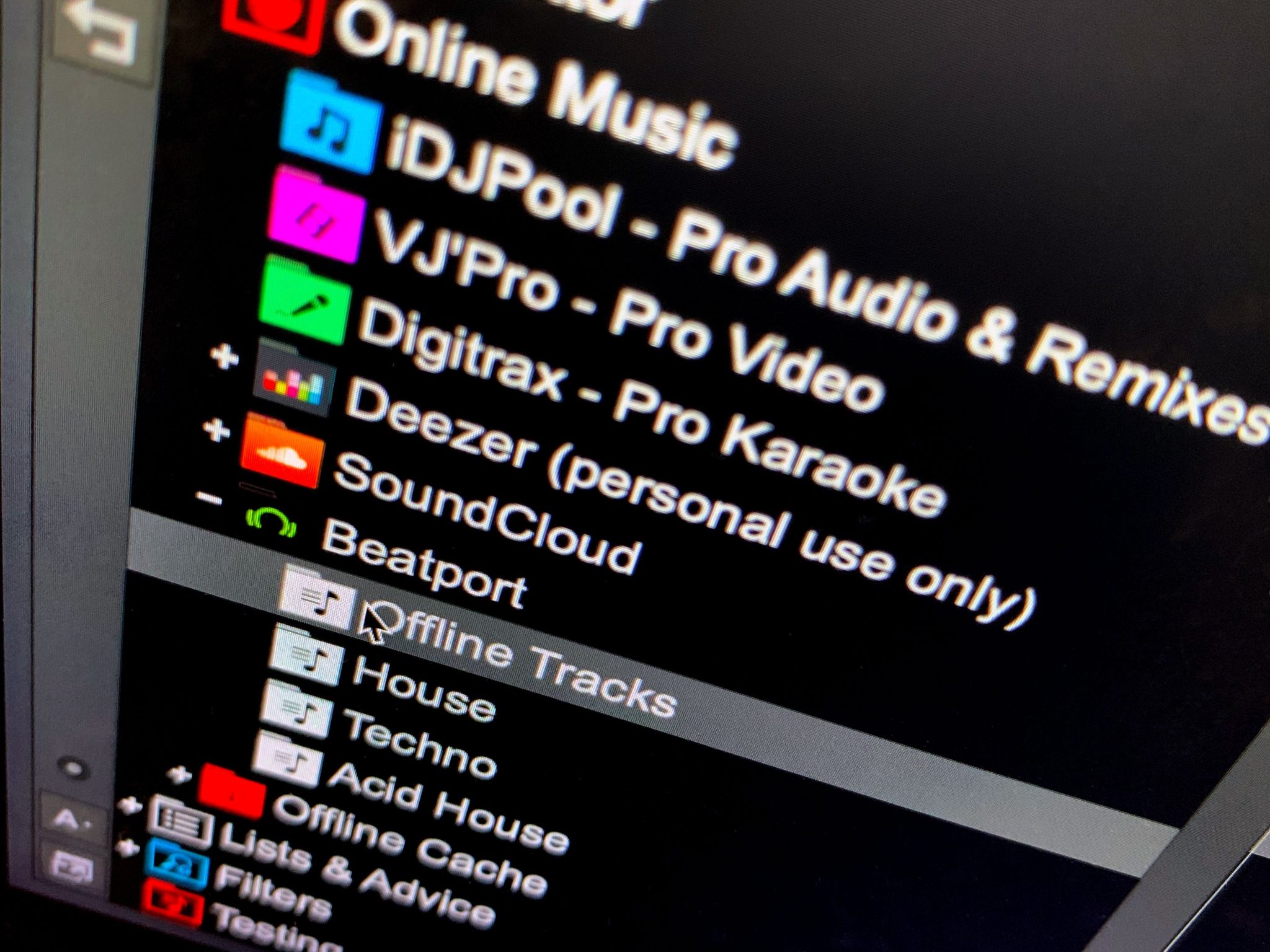
As is de rigueur with DJ software these days, VirtualDJ 2020 extends its streaming offer. It already has an expansive offer with iDJPool, VJ Pro, Digitrax, Deezer, and Soundcloud, but now it has joined the burgeoning ranks of the new Beatport Link service.
Dabbling with my new testing Beatport Link Pro account, I set about putting VirtualDJ 2020 through the wringer. And it turns out that using Beatport Link is as easy as you would expect. Like all other streaming services, you can access the premade playlists or make your own. And if you have the Link Pro subscription, you get offline tracks too (tested and working). And should you add loops and cues, they’re stored locally and load instantly.
Handy hint — Beatport’s playlist management within a browser isn’t great. But you can create playlists and search tracks to drag into any playlist within VirtualDJ 2020 easily.
It’s a great addition — not just to VirtualDJ 2020, but any DJ software. As for usefulness — I was surprised to not be able to find Sterling Void’s “Runaway Girl” on Spotify. It’s an classic House track that I used to play, and I would reasonably expect to find it there. But there’s the original and a heap of remixes on Beatport. That said, Beatport isn’t exactly going to find a huge amount of classic Hip Hop, so it’s horses for courses really. The moral of this wider story — I love Spotify to bits, but it doesn’t have everything, but nor does anything else.

SWEET HARMONY
Key analysis and mixing has been a feature in DJ software for years now. But that doesn’t mean that it’s as easy as pressing a sync button. That track the crowd loves may suddenly clear the floor because of key clashes, or if your manual key correction just makes things worse. VirtualDJ 2020 addresses this with a new smart auto key feature — when you load a track into a deck, ticks appear next to all other tracks that are harmonically compatible. But should you decide that the next track you want to play isn’t going to be a good match, VirtualDJ 2020 will autocorrect within a semitone up or down.
It is claimed that the small range isn’t noticeable in testing, but should you wish to have control back, it can be turned off. And the level of control you get over key shifting is enough that you’ll be able to make it work, or indeed make it worse if you want. Just like effects, don’t push things too far.

TRIGGERED
While we DJs have to be there behind the decks, VirtualDJ 2020 makes it easier to schedule certain things to happen at certain times via the Events Scheduler. I ever there was a feature to indicate the target user, this is it.
This isn’t especially complex right now — you can create and trigger individual actions or make a workflow of playing tracks, samples, playlists, and slideshows. You can also display text or even trigger a VirtualDJ script is you’re savvy that way. These can be timed to run after a number of seconds or at a fixed time, so you get a nice mixture of manual control. All of these can be saved for future use too.
Obviously this is aimed at events DJs who may have a very specific running order and can leave VirtualDJ 2020 to semi-automate events. I feel that this is one that will need a little playing around with to see how it will best work for DJs. I can definitely see this developing into a very powerful timeline tool.
IS THERE MORE?
Almost certainly. But this is a first look at VirtualDJ 2020’s major additions rather than a full rundown of what the whole thing can do. Others will do that for you — I’m more of a between-the-lines guy these days. But make no mistake — this is an important step for the development of the VirtualDJ.
The software market is volatile and yet static at the same time. While it’s clear that there’s little more bang and fizz that can be added to existing apps, they all do things in their own ways and talk to particular crowds, with each responding to events in different ways.
Broadly and probably stereotypically speaking, Serato DJ Pro is for Hip Hip and scratch DJs who just want stuff to work out of the box. Traktor Pro is for dance DJs (even more stereotypically Techno DJs) who want to tinker under the hood. Rekordbox is for… well that’s to be decided just yet. But VirtualDJ is for the outliers and rebels who don’t want to be seen as part of the mass of DJs that play it safe. They’re generally mobile DJs, and love the quirky ways of VirtualDJ.
They know that VirtualDJ is very powerful (indeed more powerful at times) but it doesn’t quite have the glossy image or polish that the others have, thus is not taken especially seriously by everyone. It’s something I’ve raised in the past with Atomix too. And with this release, this is something that is being addressed.
They’re appealing to a particular type of user with the new skins, and within those skins the image is more mature. I find that it’s still a little quirky in places, but importantly for me and my Mac, it hasn’t crashed. This has always been an issue with me, which suggests that the future of VirtualDJ is less about adding crazy niche features, and more about polishing what is a fully featured product into being a real player in the world outside of weddings.
SUMMING UP
Since the first Mac release, I have been a vocal critic of VirtualDJ. For too long, I couldn’t trust it to work for longer than five minutes. Mapping a controller usually crashed out on the first learn attempt. The interface was just too off-putting for me too. But VirtualDJ 2020 brings an air of calmness and reserve — it feels like it is being thought about and not simply rushing bells and whistles into it know that the die-hard fans will be forgiving if they’re not quite right at the start.
But I simply don’t have those feelings with this release. In fact, I’ve been mixing classic House tracks from Beatport Link via my ultra slow 8Mb rural Broadband without a single issue. I wished for a manual so that I could find out how to use the finer points of the new harmonic mixing features. But I haven’t once felt like it was all going to fail. I played, and it responded just like all the others, and without crashing once.
This feels like Atomix wanting a seat for VirtualDJ at the established pros table. They will argue that they already outrank/outsell/outwhatever everyone else, but outside of the mobile DJ world, VirtualDJ has yet to make a perceptible dent. But if they continue down this path of polishing what they have and marketing to those yet to trust VirtualDJ over the other players, they may just begin to win over hearts and minds. The power is there, and by the look of it, the polish is coming, and quickly.
Good work Atomix. I’m looking forward to seeing where this goes. I like the vibe so far.




Now I have to figure out how to disable that stupid autosync feature again. Not sure why the hell they thought that changing BPM to match what the other deck is playing is a good idea. Makes the songs sound like crap.
click the deck options (cog or 4-led next to cue button) and turn off ‘auto match bpm on load’
Thanks
All I would like to know about VDJ or other sw is…… how the time stretch and other “P’n’T” features sounds like compared to Serato?
Download it and try it!
Good for them and I hope it works BUT I will say it is this same thinking that actually gives them a bad name. They are always chasing……… not so much in features as they tend to be at the front but instead they are literally chasing the other developers. They clearly go after their audience. They clearly try to emulate their look. They have literally gone as far as attacking others philosophies and approach in the past as well as (seen above) offering inflated numbers never mentioning the fact they include free and repeat downloads in their numbers……….. They read Serato’s crates, they hack Serato’s hardware (I mean literally HACK sometimes) and they support everyone else’s hardware without putting the leg work into developing any (real) partnerships of their own. Move forward to white control vinyl (LOL btw) well you get the point. The fact is it all comes across as desperate and I think this will just be perceived at another hail mary. IF they were really comfortable with their position in the DJ industry they would absolutely have an alternate approach.
HAH in the past……… This is literally on their website as you read this:
Why should I use VirtualDJ
Instead of Serato or Traktor?
Each software has a different history and philosophy:
VirtualDJ
started as a software for mobile DJs and beginner DJs. Our philosophy
has always been to use cutting-edge technology to build tools that make
DJing more accessible and help existing DJs mix better.
Traktor
started in a company that specializes in making software for musicians,
and their philosophy is to try to merge the world of DJs and the world
of musicians and producers.
Serato started as a timecode-only software
used by turntablists who wanted to do the same tricks they were doing on
vinyl, and their main philosophy is to make a tool where one will use
and need all the skills one learnt on traditional turntables or CDs.
this stems from a period of time when VirtualDJ had sync, etc. Features that THE OTHERS attacked VirtualDJ for, so read those line in that context. More a argument/defense for why VirtualDJ embrace technology .. why VirtualDJ was different. Those days are gone now, since every software/hardware have since added those “controversial” features…. sync button is on all pro hardware, and a huge button right there on the deck in Serato.. :) Things have changed.. and so have VirtualDJ
https://mixmag.net/read/dj-craze-sync-is-your-friend-embrace-news
Your assumptions are completely wrong .. :)
Some of those “hacked controller” are explicitly sent to VirtualDJ by the brands..
As well often added on their website after initial sales period with link to download VirtualDJ etc..
And its not like its rocket science or a hidden thing, something to hack. . its general midi, you can map any controller yourself in VirtualDJ (or any other software with midi learn, and midi mapping for that matter. Traktor, Algorithm djay, etc does same thing..)
I have one thing to say to this. Numark NV. Literally hacked without seratos blessing and claiming/thinking this is an easy midi mapping is a reach at best. The fact you yourself say support is added AFTER initial sales period literally backs up the point they follow others hard work and partnerships. I’m case we haven’t driven the point home of vdj doing what they want with zero regard of others I’m going to add a few more elements. Groove shark & Spotify…….. I mean they are what they are and if be lying if I said the SW was not powerful or effective BUT at what cost? When do we stop thinking about what we can do and start thinking what we should. I can appreciate being the one to stand up to other SW developers in being innovative and a risk taker but NOT when it involves breaking end user agreements and riding on the coat tails of others hard work.
In fairness to Atomix, they’re only doing what most software companies have done over the years.
Software and hardware have MIDI, and a decade ago it was open season on whatever hardware came out to produce a mapping across most software. The difference now is that VirtualDJ is a purely software company, but every other software company still openly maps for popular gear. And if they don’t produce mappings directly, then the door is WIDE open to map it yourself.
If hardware companies wanted to close off their products to mapping, they could, or at least make it considerably more difficult. But they don’t. So don’t be mad at software companies for stepping through that wide open door. They’ve been positively invited.
Since when giving more options to consumers is a bad thing? In Europe we have laws to free your hardware rights.
Its this kind of thinking that gave the world customer-attacking products like DVD region codes.
PS: i’m not even a VDJ user, but i love their approach for sure
It can be taken as that for sure but it can also be taken as taking advantage of others hard work. I think VDJ is a great SW in their own right and I don’t see the need to even mention Serato or Traktor etc. is all. It comes off as desperate. Plainly put VDJ is directly after Serato’s customers NOT the other way around IMO.
BTW FWIW I can give you a TON of scenarios where more “options” are bad things. I mean customers LOVE options but what about when those options infringe on the works of others? In the US we have laws to protect the works of others LOL.
So what, specifically, do you believe is being infringed here?
Where did anyone say there was any infringement here? You asked a question and you got an
answer? “Since when bla bla?” Infringement is a when. It’s that simple. BTW we all know for a fact there was infringement regarding BOTH Spotify AND Grooveshark by Atomix just for starters but I can tell you are not really looking for credible examples here.
I just had to check – Runaway Girl is available no issues on Spotify here in the US, along with a bunch of remixes. That’s a whole extra angle to consider with streaming if you play in different countries – hope your playlist is available!
No thank you. I recently gave VDJ a shot, and couldn’t find any option for 45rpm timecode mode. When I emailed them to ask, I was told “nobody really uses timecode so this doesn’t make sense for us to support it.” I thought it was a pretty crappy way to reply, seeing as that I’m licensed. I’m sure it otherwise makes sense to other DJs, and variety is a good thing for sure.
I’m curious, can you play 7 inch control vinyl with your turntables on 45 mode or will this not work with VDJ? I’ve always used the full sized Serato control records without an issue but never thought to try that.. I know it speeds up crazy when using regular records.. the same thing happens with 45’s?
That’s an odd response given that they map all the DVS mixers they can find and make their own CVs. Were they talking specifically about 45rpm CV? Either way, it should still be supported.
It certainly used to be an option. I just found an old page on their wiki (For VDJ 7 I suspect) that mentions it.
https://www.virtualdj.com/wiki/TimeCode%20Config.html
If you’re fully licensed then you do still have access to VDJ 7.
Yep, specifically about 45rpm. And sure, I could use VDJ 7, but I really wanted to benefit from everything which is supposedly new and improved. That’s OK, there are many packages out there, and I own most of them, so I have a lot of selection. Was just really put off by the response, especially after a whole bunch of “we listen to our customers” type posturing.
The response you got was probably from a support helper rather than a member of staff. If it “didn’t make sense” then they wouldn’t be selling TCV and promoting timecode usage with videos.
You should post about this omission on the forum. There are other users there who use TCV so you should get support from them. If it’s been in VDJ 7, Atomix really ought to have it in VDJ 2020.
Not script savvy? Not a problem, because I am and will work for money.
Scripts, skin tweaks, or plugins written, hit me up.
https://www.facebook.com/VDJScriptGuru
Well feel the need to say it: I just LOVE VDJ!