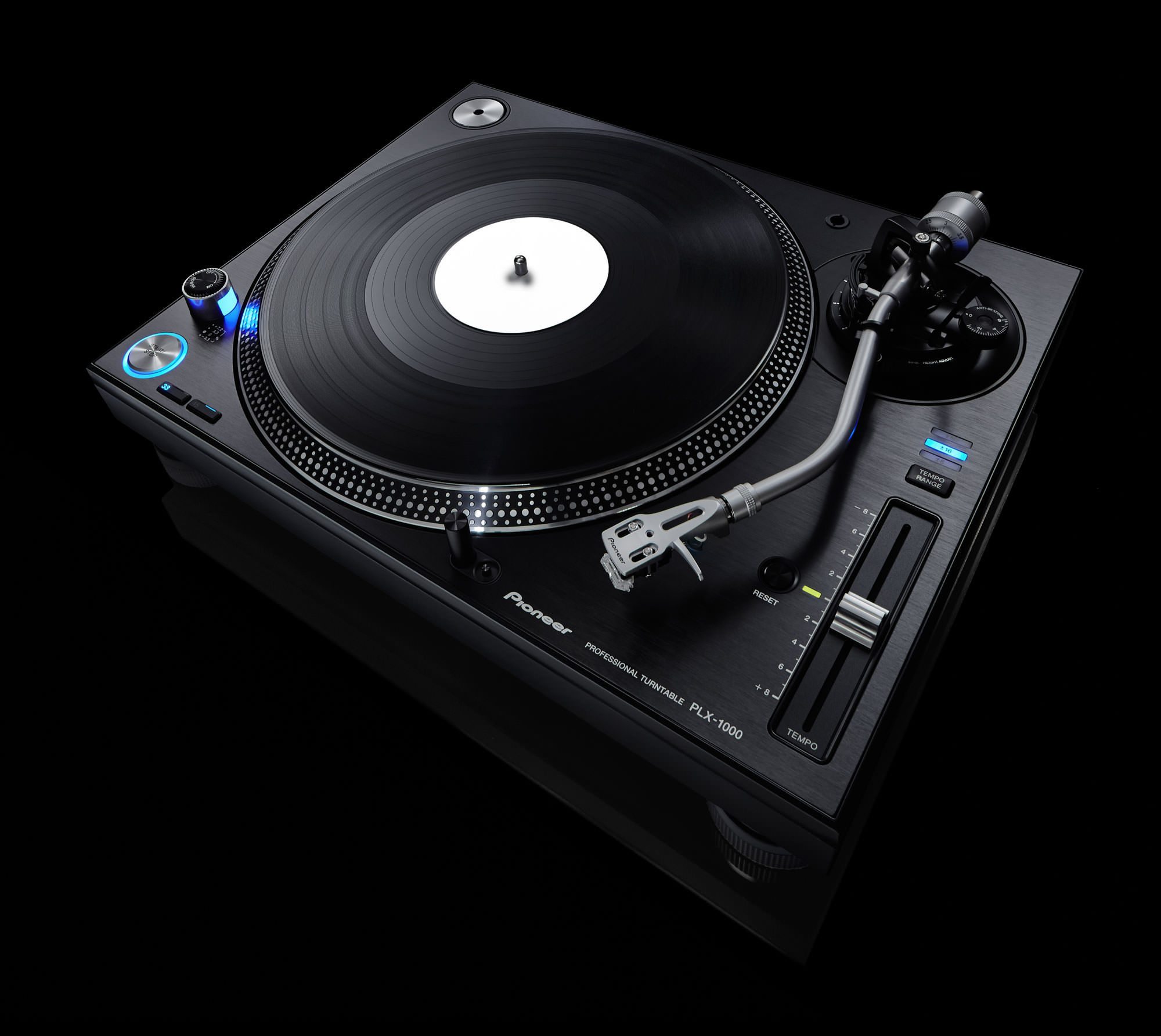
Today, Pioneer officially lifts the lid (yes it comes with a lid) on their new turntable. Surprisingly teased at this year’s Musikmesse, the new Pioneer PLX-1000 is here, and if the pictures are anything to go by, officially lovely. Cue the first of what is likely to be a stream of DJ VIPs proclaiming its awesomeness, the first being scratch legends Qbert and Shortkut, who if we’re honest can scratch better than any of us on anything.
The uncharacteristically brief words, even if you can already see what’s going on:
Born again: Pioneer DJ releases the PLX-1000 high-torque direct drive professional turntable
17th July 2014: Pioneer is marking 20 years in the DJ industry with the launch of a modern classic: the PLX-1000 professional turntable. The PLX-1000 is precision engineered for the booth, drawing on 50 years’ experience of making high-end turntables. The result is a familiar layout with some next generation improvements, including a high-torque direct drive system, multi-pitch control, club-grade build and sound quality, and detachable power and audio cables.
The PLX-1000 is available from late August 2014 at an SRP of EUR 699/GBP 599, including VAT.*
High-torque direct drive (331⁄3 rpm in 0.3 seconds)
Classic DJ turntable layout
Removable power, ground and phono cables
S-shaped tone arm
Multiple tempo control options: ±8%, ±16% and ±50%
Tempo reset button
Solid build for excellent vibration damping
Professional-grade gold-plated RCA jacks
Rubber-lined tone arm to improve isolation and prevent feedback
MAIN SPECIFICATIONS
Turntable
Power requirements
AC 220-240V, 50 Hz/60 Hz
Power consumption
9W
Main unit weight
13.1 kg
Maximum dimensions (W x H x D)
453 x 159 x 353 mm
Output
RCA × 1
Drive method
Quartz lock servo type direct drive
Motor
3-phase brushless DC motor
Braking system
Electronic brake
Rotation speed
33 1⁄3 rpm, 45 rpm
Rotation speed adjustment range
±8%, ±16%, ±50%
Wow and flutter
0.1% or less WRMS (JIS WTD)
S/N ratio
70 dB (DIN-B)
Turntable
Aluminium die-casting diameter: 332 mm
Starting torque
4.5 kg/cm or more
* Cartridge not included
Start time
0.3 seconds (at 33 1⁄3 rpm)
Tone arm
Arm type
Universal type S-shape tone arm, gimbal-supported type bearing structure, static balance type
Effective length
230 mm
Overhang
15 mm
Tracking error
Within 3°
Arm height adjustment range
6 mm
Stylus pressure variable range
0 g to 4.0 g (1 scale 0.1 g)
Proper cartridge weight
3.5 g to 13 g (single cartridge) – When shell weight is used: 3.5 g to 6.5 g – When only balance weight is used: 6.0 g to 10 g – When sub weight is used: 9.5 g to 13 g
Included accessories
Turntable, turntable sheet, slip mat, slip sheet, dust cover, head shell, balance weight, sub weight, head shell, shell weight, adapter for EP record, power cord, audio cable, ground wire, operating instructions
What is the PLX-1000?
Obviously it’s a turntable duh. But essentially it’s Pioneer surveying the current and future market, looking at their range, and seeing a turntable sized gap in it. It’s clear that the venerable deck isn’t dead just yet, but with DJs still utterly loyal to the deceased Technics brand, Pioneer is banking upon its established DJ brand kudos to offer a replacement in the same vein, but updated to fix all the stuff that was wrong, and to bring features that other turntables don’t have.
When I say wrong, I mean having removable power and RCAs. This is one thing that I would have thought would have been changed over time, but at least Pioneer have done it properly. As for new (to Technics) features — high torque and pitch ranges up to 50% are standard. Those wanting science fiction style features need look towards other companies to start pushing the boat out a la Reloop RP-8000. Sadly, there’s no reverse.
There’s no denying the looks — the PLX-1000 is gloriously black with essences of chrome/nickel/silver or whatever the shiny stuff is, with just a hint of blue lights (invoking to now standard “sorry Dan” here). And while there’s nothing adventurous cosmetically, the iconic rectangular Technics has been replaced by the equally iconic circular Pioneer one. But essentially this is a solid sexing up of the established turntable ID. The pictures look amazing. I guess we’ll find out soon enough if the effect is the same in real life.
It appears that beauty is not just skin deep though. Inside the belly of the PLX-1000 is some invisible vibration damping rubber tech, both in the tonearm and the chassis. It also adds to the weight too — the PLX-1000 is a good kilo and bit heavier that a 1210. You see — it’s not just a make-it-pretty-and-stick-a-pioneer-logo-on-it job — I guess if Pioneer of all people are putting out a turntable, it should be a good one. Hanpin is clearly involved, but like the Reloop and Stanton decks, the PLX looks to go someway beyond the standard super OEM template.
OH THE IRONY
Pioneer’s CDJ range has been in part responsible for despatching turntables from the DJ booth, or simply relegated to being a laptop stand. And here they are offering their take on a very established format that they in part helped to push towards extinction. Perhaps it’s an act of contrition, or simply seeing the need to plug every possible gap in their product range. I’m under no illusion that Pioneer expects to sell boatloads of these — no manufacturer would predict a return to the heady pre-digital times. But it’s a nice thing for Pioneer to do anyway. The PLX-1000 appears to be a frills-free lump of quality from an iconic brand that looks the part and should deliver everything that a turntable should.
PLX-1000 SUMMING UP
The PLX-1000 is Pioneer’s take on what the market needs, and the market still seems to need Technics 1200s. So instead of over-thinking, Pioneer made its own 1200, but made it better. Without a time machine, there’s no way of knowing if the main selling point (and arguably downfall) of longevity is the same. but feature for feature, the PLX-1000 has Technics beaten into submission. The issue will be price, and the notorious Pioneer tax is playing a part compared to its peers. The PLX-1000 plans to extract £599 from you, but the established players are up to £150 cheaper and offer the same features. Even the Reloop RP-8000, with all its MIDI magic is still £75 cheaper. But when has a lofty price tag ever stopped Pioneer from cleaning up? It’s all about the brand.
The PLX-1000 will be available late August for $699/€699/£599, including a dust cover for you to put under your bed too. Just add a cart of your choice and your off. I imagine Ortofon already have something planned, but I do spy a Shure cart in the pictures.
To be fair, Technics were around that price at their most expensive, weren’t they?
Yes they were, but if I recall that price point was when it was rumoured that they would be discontinued.
Oh, I’m talking about the late 90s or early 00s.
Different times. I have no idea how the price equates with inflation etc.
Not even accounting for inflation the MK5g’s (“Grandmaster Edition”) were actually more than these when they were announced. That was about 11 or 12 years ago.
The mk5s were on the same price range, but they were announced from beginning as limited & everybody knew they were going to be the last product of Technics.
The price of the PLX is ok, but a bit salty. Still, I would buy one as long as I can test it before buying. One thing that every new TT advertises is motor torq, but this can be very frustrating if too strong. The mk2’s torq is absolutely on point for turntablists. The only thing we are missing is 50% pitch range, something cleverly covered by Pioneer.
I prefer a strong torque. I always found the Technics lacking in this respect.
In juggling, backspinning with a strong motor can be a pain in the ass.
How can this be if you are using proper slipmats?
More torq= more force needed on the record to backspin the same as in a mk2.
PDXs gave a lot of trouble with this.
I don’t see how this can be true. You are spinning your slip mat, NOT the platter. Torq should not affect these things. What it will effect is start-up time.
I am going to try and be polite, no pun intented.
Have you ever tried scratching? In case not, scratching incorporates countless hand starts/stops of the record & the platter, especially during drags. Obsiously, between the platter and the slipmat there is still friction, otherwise the record would never start spinning again when you pressed start or released it after a drag. This tiny ammount of friction between the platter and the slipmat is increasing the more torq a TT has, while still using exactly the same slipmat.
Now, in case you indeed know how to scratch, I have nothing more to add. In case not, you can try it at some point and see for yourself.
The MK5g’s (most completable Technics to these) were actually more when they came out. And that was almost a decade before they were discontinued.
ITT: People asking if you can plug in USB sticks…
Nice article Mark covers all the bases on this one. Pioneer filling the gap. I think they may have just extended the life of vinyl by a few more years. If these are war horses like the technics then maybe by another 20 years or so.
So is it an super-oem motor or not ? wow&flutter 0,1 % ? thank you I will keep my technics ;)
it has torque like the stanton 150, wonder how will it feel, i love the torque on technics, its perfect for record manipulation.
More expensive than other brands, yet people will buy it just because it has Pioneer on it.
Missing:
– Extra start/stop button for battle mode
– Reverse
-Start and brake control
– MIDI
– Phono/line switch
– Detachable and easily replaceable target light
Probably even a few more extras that others do have. At a better price.
Missing? Probably more appropriate to say “could have been included”. Technics didn’t have these, and the PLX-1000 has been designed to emulate a Technics.
Valid point Mark. I meant “missing” because other brands do have (most of) these options, at an even better retail price.
As a Technics replacement, it’s a good choice, if you want the Technics design (though that start/stop button is obviosuly Pioneer design ;-) ). Stil, there are other alternatives with the same or similar design and mostly more options. And they’ve been around for years.
This shows real faith in vinyl. Pioneer won’t have taken this decision lightly and their is gear is generally really good.
What will be the other colours? Knowing Pioneer, we will soon see the White PLX1000 and then maybe a silver limited edition one?
I have absolutely no doubt that this will happen.
Because that’s the most important thing, the colours ;) Now i know why compenies are releasng shitty products where all it matters is the looks ;)
When a new product is released, the vast majority of comments start with “looks…”. And no matter how you try to steer them to talk about what it does, sometimes the cosmetics override features. DJs do care about image, and more than they would care to admit.
Pretty in pink??
beaten Technics into submission? you must be kidding me, its april’s fools day?
I agree. How can you make such silly claims before this deck has even the market. These are far from affordable for one thing. Another, let’s wait 30 years and see if these things are still rocking. How available will parts be? How available will customer service be. Besides the addition of unneeded rubber in the unit, these are still just super OEM decks with a stupid price tag.
I would love to try one out, but to say they beat anything into submission is just silly.
Let’s just re-read what I wrote:
“Without a time machine, there’s no way of knowing if the main selling point (and arguably downfall) of longevity is the same. but feature for feature, the PLX-1000 has Technics beaten into submission.”
Granted, we have no idea if they’ll last. But comparing key features, the Pioneer has removable gold plated RCAs and a removable power cable (both weak point on Technics). It has 8, 16, and 50% pitch too. And let’s not forget the powerful starting torque either.
I get that people want to defend Technics, but my original statement is still true.
more feautures doesnt mean its a better turntable, it just means more features, if its better than Technics then it will be over $1000, look at the wow & flutter of 0,1% versus Technics 0,035%
yes removable RCA and higher pitch i miss on my 1210s but thats about it.
I’ve seen this wow and flutter stat kicked around a bit today. I’ve never had a single issue with wow and flutter on any turntable I’ve used. Has anyone else? It’s not as though though it’s ever been reported as a problem with super OEM decks, and after doing a little unscientific asking around, nobody has ever had an issue either.
1% wow & flutter can mean up to 1% random variations in the pitch while mixing 2 records. That’s quite a lot in a brand new TT, but to be honest I’ve never seen a mk2 with less than that, usually caused by overused pitch faders.
But it’s not 1%, it’s quoted as 0.1% or less. Some audiophile turntables are quoted at 0.2%.
Sorry, my bad! 0.1% that is, compared to nominally 0.01% of the old mk2, when brand new.
Still, most second hand mk2s are plagued with way more than that, so I can’t really see a problem.
Super OEM’s have been more feature packed than technics for a long time (& more feature packed than this deck). But no other super OEM Has ‘beaten Technics into submission’ before. Is it possible that you’re playing into Pioneer’s prestigious marketing. Especially seeing we haven’t even touched the deck yet?
Pioneer does make good gear. I’ve liked all my pioneer mixers but the comment does seem at least to jump the gun!?!
I thought the exact same when I read that!
So it has higher torque than a 1200?
Yes. Most DJ turntables do. Not a dig, just an observation.
Yeah. Just wanted to know if they are trying to replicate the feel of the 1200 as well as look.
At $700USD, it’s a little too rich for my blood. I already own two STR8-150’s, and I don’t see how the PLX1000 (or even the SL1200) is any better for the price.
Not sure if this is the same as Stanton and other oem players or not? Specs looks similar to the Stanton, but S/N ratio much higher.
That’s PROBABLY due to the fact that they removed the pre-amp board more than anything else, I’m betting these are Super OEM and just a quick way for pioneer to make a buck, they do look DAMN SEXY, but so do the Reloops and they have more to offer. I have a feeling passing through that preamp PCB adds a bit of noise, which is why some people remove and bypass it, which is an especially popular mod on the very similar lp120 from audio technica, and results in a marked increase in SNR.
Wait… so in a market filled with turntables that have a slew of really interesting features, including MIDI, USB recording, movable pitch controls, removable tone arms, controls organized for multiple play styles, etc. THIS is exciting?
This, to me, is lazy. It’s a carbon copy of a product that is… 30 years old? Maybe 20? The marketplace is made up of units being made in the now, pushing boundaries, something we’ve come to expect, at least a little, from Pioneer. What Pioneer is asking of the consumer is to either buy a used pair of Technics for around half the cost of their new turntable, or for the same price get a TON of more features? Hell, you can get the RP-8000 for the same price, the STR8-150 for less and the TTX (with a working motor) for less. What does the PLX-1000 have that they don’t? Other than, of course, looking almost identical to a Technics.
All very logical points. But it’s a Technics with a Pioneer logo on, which in itself could be all the fancy advertising copy it needs.
You could make the most space age turntable with features that nobody had every even thought of, that defied the laws of time, space, and physics, and turned you into a disease curing peace bringing chic magnet that won the lottery every week. But some would still say “Technics for life”.
Yeah, but those people aren’t going to buy this turntable either, since it’s not a Technics. It isn’t even a Technics with a Pioneer logo on it. It’s a Pioneer turntable that looks like a Technics. If Numark did this it wouldn’t be hailed as anything other than Numark trying to be Technics. But since it’s Pioneer it’s okay for them to do less?
That’s the weird part about this whole movement. The people who want Technics already have them. And are they going to move away from their trusty Technics for a more expensive product that has barely any more features? If so, then I hope they know there are turntables with better features and just as much power as this one.
Why market a product to people who only want a specific product they will never get?
There’s a philosophical difference, I think, between your position and someone who would invest in high-end DJ turntables: These aren’t supposed to “push boundaries”, they are supposed to play a song, every time, in a variety of adverse conditions.
As far as Technics loyalty: I think in the absence of Technics, with another true workhorse available, people will compromise their “orthodoxy”. I know I will; as the Technics in my club fail, I’ll be replacing them with these.
rs
Spot on Ryan. Unlike most of the turntables on the market, these will be installed in venue’s where quality over price matters.
Quality, based on what?
But what makes these more “high end” than the Str8-150s? And how are they not work horses?
We don’t actually know how reliable these things are over the long term. We don’t know if they are custom built or just OEM turntables. What about the spec list, or even the look of them makes them more reliable than any of the other turntables on the market?
Better the devil you know.
My point exactly. The thing is though that people are sheep. It has the Pioneer logo on it and everybody sreams “take my money”.
People aren’t responding that positively from what I’ve been seeing. Granted, I see a very curated view of DJs, due to who I am friends with. I don’t really see anyone getting extra excited, though, y’know?
I’m sure there are kids jumping up and down cause they can have a turntable with a play button that matches their CDJs… but my turntablist friends can’t seem to care any less.
AGREED, MY THOUGHTS EXACTLY!
Just an observation – why is the 0% pitch light green? Shouldn’t it be blue to match everything else? And then Ortofon could to a PLX cart in matching blue too.
Technics style ;)
Orange would be a better choice to match the blue, or even a red pitch led
They’re saving it for the MkII!
Remember Mark the CDJ pitch reset lights green.
I think Pioneer have released a basic turntable to allow for future updates with ‘bells & whistles’ attached to entice us to spend more cash in time to come.
yeah yeah made it better….sure….still technics 1200 are the best after more than 40years on market!
problem: technics not really on the market anymore
they high in demand, i know, i sell them on the market
I have one that has performed flawlessly since I bought it decades ago. AT cartridge.
on the market
phrase of market
1.
available for sale.
“he bought every new gadget as it came on the market”
good, I’ll take two brand new in the box. You got them then, I assume?
The only thing really missing from my POV is a digital pitch adjust like in the M5s, which really cut down on maintenance over the life of the deck.
I’ll have to give Pioneer props for doing this, They really have made a good looking deck! However it’s really lacking by today’s standards. And…. at that price I’ll much rather get myself a set of used SL’s. Honestly, I can live with the rca’s & power cord connected. 16% & 50% = Meh!
its not lacking, today ppl still want a basic solid deck and all the bells and wistles put in the mixer in between, its safe this way, if you get a deck with many features then chances are big something fails after 10 years
I’ll be very happy if these decks last 10 years but I really think it may be wishful thinking. Maybe in 10 years if they’ve proven themselves I’ll buy a pair :)
My super OEM are 11 years old and are performing like new so you can buy a pair :)
I can only think of one good reason Pioneer have released these – because they believe they can capture the club market for vinyl now that Technics is dead. There are still loads of DJs using vinyl and DVS, and with vinyl sales on an upturn, vinyl is cool again. There’s no better time for a reputable brand like Pioneer to release a turntable. Why haven’t they added loads of extra features? Probably the same reason that they didn’t overload the CDJs with them. Bells and whistles are things that can break and it never held Technics back that they didn’t have them either. It will make them appealing to clubs and the fact that they weigh more suggests that the build quality may be up to par too. Smart thinking from Pioneer.
Spotted a couple of errors in the text. First, “iconic rectangular Technics” what? Second, there’s a your instead of you’re near the end.
I vote for a Super OEM showdown ! Auido Technica, Reloop, Stanton, Pioneer all reviewed together to see what you get for your money
Definitely, a Super OEM shootout/showdown/throwdown/whatever is needed.
Oh god why? What difference does it make? Who needs these?
After researching a bit more (it’s even mentioned in this article) it seems that they’re using hanpin to pump these out, just like stanton, audio technica, and reloop are doing, wish they would have made them themselves… then they’re charging a premium for them just because they say pioneer, which is to be expected. WOW and Flutter match stanton and reloop specs, it’s just another super OEM with a heftier price tag because it says pioneer. Sure it’s sexy looking and it says pioneer on it, but I’ll take the Reloop, or the Stanton… everything is the same but you get MORE features, reverse, line out, adjustable torque on the reloop so you can still spindle-pinch easily if that’s your thing, and adjustable start/brake, plus a straight tonearm variant on the stanton, hell even the new DJ tech offers more than this, unfortunately Pioneer isn’t offering anything that hasn’t been done better by someone else already this time, super oem is super oem, they just removed some features… it’s a cheap attempt to make a turntable that actually cost them LESS to make than some other variants of super OEM that cost LESS, and here I was, all excited.
Yeah I’m disappoint it’s just another OEM
My thoughts exactly, but I can still imagine many an argument of “yeah, but pioneer is way better quality than reloop” with people that just don’t get it.
The sad part is you’re so very right… people are sheep. I just hope the reloop 7000 comes down in price because of this, that’s the deck I want to replace my stantons with.
reloop 7000 is basically the same as Stanton STR, why would you want to replace them? same factory aka Technics clone company.
Good point…. but I guess his previous arguments don’t apply to himself
I don’t have the 150s, I have the old str8-80s, saving up 1200 to drop on TTs is hard for me. The 80s don’t let me down but I do want something nicer.
Dude if you don’t like it don’t get it…but for those of us that trust the pioneer brand,we’re getting it no matter what you say…it’s called choice…if pioneer designed it,Hanpin just made it a reality…everything begins with DESIGN,testing then to the production floor….nuff said
I have to admit it looks amazing, but if it really is just another Super OEM then I can’t see how it’ll be any better in use than my STR8-150s. They’re cleverly priced, too, Pioneer have clearly thought hard about exactly what is most people are likely to pay for the badge!
We could argue all day…your obviously on the “this is a stupid waste of time product” side.. The other side that will buy it says this 1) I read all the comments that you can get 1210’s or 1200’s for half the price on Craigslist or eBay or whatever. But from what I have seen looking for a quality used pair is difficult and actually more expensive than these and I have looked in NYC, LA and Miami. 2) because the 1200’s are built like a tank, many of the used ones look like they have been through a war and most people take pride in playing on equipment that doesn’t look like crap especially those of us that do it for a living in public venues. To pay for a good looking used pair of 1200’s will cost you a mint. 3) a lot of people like new stuff and playing on 10 year old equipment doesn’t excite them 4) Pioneer obviously did a lot of homework and has the technical back ground to build whatever they wanted but DVS users or people that just play vinyl don’t want extra features. Just want a Pioneer turntable to go next to their DJM…it’s that simple.
Your points would all be valid if they made it themselves, instead of using hanpin, and the wow/flutter was more comparable to techs, both of which they would have been capable of doing with their resources, had they actually cared to, instead of half assing it and just putting out another cookie-cutter super-oem with slightly higher than average SNR
How is building a quality product…which Pioneer always does..half assing…if people want a basic turntable that isn’t 10 years old then build them one…why go thru the trouble and money of building something the DVS crowd doesn’t want, which would cost a lot more..I don’t get it. Pioneer made a turntable that satisfies the technics lovers..period..it does have a couple features that aren’t on the other OEM tables..It costs what you would pay for a decent used 1200 with the backing of Pioneer and a warranty. Plus it’s going to replace the 1200’s in clubs around the world overtime so you can play on club equipment at home..that’s good enough for me.
i think hanpin made the turntable, not pioneer, they just designed it.
Pioneer DJ products are always the highest quality whoever builds it.
People like you are what’s wrong with this industry… it’s made in the same chinese factories of the same parts as other chinese turntables, with a different faceplate… reloop took these and tailor-made them to the same extent pioneer did, and did something FAR more interesting.
People like me? Apple makes everything in china with Foxconn. So does everyone else but their quality is never questioned because they make sure the company that builds the computers, laptops, iPhones, etc meet their high standard..and they pay more to Foxconn for the increased quality. Pioneer is the same.
People like you that judge everything on price and where it came from are what’s wrong with these comments and forums. Just preface your comments by saying I don’t want to pay higher price..that’s fine.. But all the rest doesn’t matter much to most people ( evidenced by Pioneer sales) we all must think there is more to it than slapping a logo on equipment. You buy the FAR more interesting Stanton or Reloop
I never said anything about the price, I said it isn’t as interesting as the reloop, which is essentially a different version of the SAME TT made in the same factory.
not true, the faders on pioneer DJM mixers are not as good as let’s say a Rane Magnetic fader, if you really want a great mixer with decent efx then there are much better choices than pioneer mixers.
Matter of opinion. The faders on the DJM 900SRT are great
Yes great but not better than Rane Magnetic faders, it’s not an opinion, more like a fact.
Different market for different people.
Fact? The DJM900SRT is different than the DJM900NXS and is made for the same market as the Rane mixers. It’s like saying a Ford is better than a GM…not fact..opinion.
No Rane mixers are made with the turntablist scratch DJ in mind, Pioneer DJM mixers (with the exeption of the classic DJM-909) are made with the club DJ in mind, hence there is a huge difference in fader quality.
Sure both can be used in clubs but if you check the DMC online competition then you will see the Rane 61/62 mostly and not Pioneer DJM900SRT.
How is the cut in and curve on the upfaders of the DJM900SRT? and reverse option? You can do a Euro scratch on the DJM900SRT? i don’t think so, unless you prove me wrong
When Pioneer made the Serato version of the DJM900 they made it for the turntablist scratch DJ. They upgraded the faders to higher quality. The DJM900NXS is made with the club/Traktor/Rekordbox DJ in mind (although it is Traktor Scratch Certified but that is mainly to eliminate the Traktor sound card from the booth) The DJM900SRT is made with scratching in mind and everyone uses Rane in mixing competitions because it is the historical standard (the same argument everyone makes in the comments about Pioneer mixers and the club) doesn’t mean its a fact they are better. just an opinion ( might be a widely held opinion , but still an opinion) . Same thing with using the Traktor Z2 as a battle mixer. It’s a choice..not lesser to a Rane by fact.
The Rane mixers are the standard because they integrated SSL into their TTM-57. Prior to that, you could bring (and still can) any mixer you want to a DMC comp. But now that DVS is allowed, many use SSL and are content with the TTM-57 or TTM-62. As far as fader quality, I’ve never been a huge fan of Rane faders. I’ve owned the TTM-54, TTM-56, TTM-57, and a TTM-62. Why? Because when I spin at events that’s what’s there. My favorite mixer? The Rodec Scratchbox. The faders are WAY better (in my opionion) than the Rane. Keep in mind that I always have to have an SL2, SL3 or SL4 with me and that is the trade-off. I don’t know how the faders in Pioneer mixers are but I do know that their CDJs felt like plastic toys so I never took to them (I’m a turntablist at heart anyway.) PEace, love, and resPEct guys.
Ha! Best comment on the page!! Kept me laughing all night!
Let’s see… 4.5kg/cm force… most super oems have that, 50% pitch range, most super oems have that, removable RCA/Power, most super oems have that, the only thing it has that most don’t is a properly placed 45 adapter hole for dicers, but you can stick dicers anywhere so that doesn’t even matter. What are all these features that super oems don’t have? The better signal to noise ratio? Yeah, that’s really interesting, if you’re playing real vinyl, which let’s face it only 5% of the people who buy these will actually use it for. So no, it doesn’t have any features that other OEMs don’t, in fact it has WAY LESS.
Let’s see..a lot more people than 5% of the people buying these will be playing vinyl…probably more like 50%…2nd the internal dampening is huge if you have ever played a club with bass that moves the needle no matter how well the tone arm is set up. So the two most important things 50% of the customers need…sound quality and built for club use it has that other OEM’s don’t.
I guess it fills a void. Maybe numark will bring back the ppd-2400! I’m betting cdj2000nextusmk2 at dj expo
I think the PPD stuff is out. Numark tried to bring the branding back for two mixers and the big brother 4ch’s quality control issues were never resolved, so they dumped the brand again. It’s strange how Numark has such a good base and DSP-controlled motor of their own, yet their pair it to crummy plugs, and a non-standard inferior geometry tonearm with a joint alignment meant for strait arm scratching. Also, none of Numark’s current standalone USB/card players will do lossless.
The Technics 1200MK5 was released in 2002. A used 1200MK5 (which is a unit between 4 and 12 years old) in VG/EX shape seems to be going in the $500 shipped range, with NM examples with boxes going higher.
An extra USD $200-300 doesn’t seem that bad for something (supposedly of comparable quality) brand new. I think maybe this is a “live and learn” thing, but in my experience a musical instrument, which one intends to perform art with, isn’t really the place to “race to the bottom” on price.
rs
Give me a link where I can buy it at that price then Ill agree
I’ll pass. 8 decibels more rumble than the EARLIEST 1200 MKII, and at least 10 times the wow & flutter? LOL
but it has a pioneer logo on it – it must be good. everybody uses it. it will make me a superstar-dj in no time.
Rumble? Are you looking at the S/N ratio? Surely the level of extreme low end reaching your PA is going to depend more on what cart you fit (its freq resp), what type of mat you use and especially the RIAA EQ in your chosen mixer, and whether the mixer filters out the rumble freqs.
Wow & flutter – well it does say “or less”. It could be the same or even better than the SL, but they just haven’t specified it. :-)
True it could be a conservative W&F spec. And rumble has far more to do with isolation and blocking of the turntable from sound sources than how well it’s built, but it does have a slight effect. I’m curious about the power supply’s RFI characteristics.
Techs actually run at around .035 by the measurement standards we use today, so it’s slightly less than 3 times the wow and flutter, but I agree that they should have gone the extra mile to match them.
What if these really become the industry standard again next to the CDJ’s? How many (sync) DJ’s we will laugh at? What about the DJ’s in the magnificent DJ Mag Top 100? And maybe even more important; what will dance music record labels do? Still releasing everything digital for Timecode players or….bringing back the good old great vinyl releases?
Having actually seen and had a go on these in real life, I can confirm that the PLX1000 is as close, if not better than a 1200/10 as far as feel and usability goes.
I have had, and still use my Technics SL1200’s since 1999 and was pleasantly surprised when Pioneer showed these to me, as I was very skeptical about whether or not they would be any good.
I was very impressed with the quality of the built and, more importantly, how they felt to mix with. Props to Pioneer for filling a gap that was left when Panasonic stopped producing our much loved SL1200/10.
If you want a decent pair of brand new turntables these are the ones I would recommend. My only gripe is the blue LED on the strobe, I would have preferred a white one, but there you go..
All I will say is wait until you have used them to pass judgement.
The PLX-1000 tone arm is exactly like m5g techs. I’m very excite to put my hands on these babies. Plus im looking forward to the hi torque motor.
The s is just like an oem and panasonics doesn’t deny the motor is from an oem, otherwise ir’s strange to get the same torque nonsense , which is useless, but the audioside just score too low, watching the numbers and the don’t deny that it ain’t an oem inside but knowing pioneer, not filled with chinese shitty caps, but still using the ancient pcb , with the cheap transfor and shuilding… never heard off. Only there’s one thing which nobody talks about, you get a couple of years guarantee, which is prrfect when you just start or don’t like diy, since most owners of 1200mk2 and 1210mk2 nrever have heard of maintenaince and still think theit wow a flutter number have any meaning. I only buy mk-5 since te rest is just old shit with 25 year old caps wires etc and then it becomes quite an expensive old piece of gear to get it in to a good state, repainting ain’t a real problem , if you turn in your old cabinet and buy a painted one, but you have to replace the tone-arm or atleast bearing, wire, all those caps, smd pots , but after first claning the pcb’s , respraing in them and placing new plarts and wires and the paintjob and checking the motor, it’s perfect and puoneer won’t sell anything loose, like all the oems.vestax does , only you need to get it from englang, but the 3000mix is a very nice table and quality/option/mone- wise there ain’t no better one to buy , yes the m5g… which cost you 500 euro more. Nice colour i have to say, but besides some improve ments iyt’s still no hifi grade table. But i think we’re all to critical and take the whole thing to serious. I you like the pioneer, buy it, if you like a superoem buy it, if you like to upgrade gear, buy a technics and the wow and dlutter—> buy a 500 dollar Hi fi table( not the pre-amps: ripoffs) , but pls ask which kind of capacitors you get, even hi-fi put cheap ones in it phone pre-amp stuff In their lower grade hifi which is sad. And shich is better?…. a synq scrTches perfect and the puoneer will just be like a standard oem table, only o,3sec to full speed , but the fun is that after that the electronics kick in and pioneer never says something about it.I would ask to see the inside and since they use a show model and then won’t do it, don’t buy it. And everystore has a blueprint which is certified to sell them. 700 euro for a chinese gear tt is too much money. Then you have a bargain with the reliop 7000 or 7000 ltd(nice white), costing only 400 euro… a bargain and for normal tt use eveything you want and peoples which think that usb and a digital output is better…. Check how much these converter cost…. real good omes. Digital really ain’t negter at these price points, you only pay 60 extra for a shitty converter
What do you mean torque nonsense? High torque is good, you get up to speed faster and it’s easier to mix. Ever try some cheap low torque direct drive decks? Ugh.
Has anybody taken into consideration the cost increase Pioneer building these themselves would add? Handing them over to hanpin means they don’t have to recoup the cost of the entire machining creation process.. just a few specific parts unique to pioneers model. I would imagine recouping that initial investment would add $100 bucks or more to the base price. That said.. As a Super OEM I would have liked to see a few more forward looking features. USB/MIDI at least..
as i said on DJ forums, I’m convinced Pioneer have bought the rights to the technology Panasonic used for the 1210 motor, its not been released but why else would they basically re-create the 1210 and expect it to sell, and why would Panasonic not sell off the rights to something they don’t even need any more
I don’t know if there are any rights as such to buy. Patents aren’t for life.
I’m not that up on the ins and outs of it all but I’m sure I recall something where the quartz motor was exclusive to Panasonic/technics, I could be wrong mind. I’m just convinced Pioneer have been in talks with Panasonic about them continuing the product with their own brand. Either way I love the idea of this becoming the next fashionable thing in the worlds DJ booths. Not that the places I play at will ever get any
there were direct drive quartz motors made by Denon in the 80s, shame Denon stopped making DJ turntables, they could have beaten Technics being a proper manufacturer, I never cared about their digital players
That patent ran out years ago. Patents are only good for 20 years. In fact the Numark ttx has the same basic motor design. Even gemini released a deck a few years ago called the tt04 with a similar motor.
As far as I know, no DJ turntable has ever been linear direct drive except the Technics. All the others were pulse-based, with the slight exception of the high-frequency DSP-controlled units that came out for a while. That patent may have run out, but as far as I’m aware, no company has ever tried to actually clone the Technics, let alone improve on it. Is the Pioneer a linear analog direct drive motor?
I don’t think it’s the same motor since it has a higher wow and flutter rate.
PS this story has kicked up a right storm hasnt it
Next expect a SL-DZ1200 clone named Pioneer…coming soon with more torque and Pioneer style play/cue buttons.
Ha. No.
So I guess Pioneer just thought that “grondbreaking turntable” is an oxymoron.
Just one thing, spec-wise: 220V only? So I guess it’s not gonna ship worldwide?
The PR comes from Pioneer Europe hence the 220/240v. Of course they’re going to ship worldwide.
I dont know why people are wanting it to have the same motor as a 1210. The motors on Hanpin are far better for mixing. Yes technics may have less flutter but making very small adjustments is not possible on a technics with only using the platter/spindle as the platter is locked in segments to the motor. I have both and much prefer STR8 150s to 1210. For this reason I will very likely buy the pioneers.
Technics 1210 was not a nice and easy TT to dj with. Nor is it a suitable home hifi deck either. My point is, out of the box, they needed modification for the purpose they were ment for. Kill the Quartz if to DJ with, or externalize the PSU if you had it home. Better yet, to rip vinyls.
All respect to a rock solid work horse never the less.
At my resident space, i did the quartz hack and everybody loves them saying they are just as smooth as a CDJ.
While it’s true the multi-voltage Technics have EMI/RFI problems from their power supply, just like many of the other brands out there, the single-voltage units didn’t have much of an issue. And the Pioneer does not appear to have an external power supply, does it? The Technics tone arm bearings are also comparable to a lot of audiophile aftermarket tone arms. You cannot say that about any other DJ deck brand.
My PSU was humming like hell. Very present in the speaker, but it could be faulty.
And i agree on the Stock tone arm, It is actually pretty good arm for home stereo use.
I never heard of this quartz lock hack. I’m gonna have to look it up.
ever took that shitty oem apart ? , terrible build and i don’t say the technics is perfect put it samples his speed fout times more then an oem and tell me where i can get parts for a oem easily. No, i hold on vestax, thet outperform a oem and technics , just the pdx3000mix and if you want that torque nonse, god may know why,,,, it has a lot incl way better abs then in the old days, like on the superoems, buttoms, feet, underdeck, knobs . Bur you ain’t have a phd micro-electronics i assume?. OPEN the unit and look at the shit you’ve bought. I bought also two, since a coyple of major sides said they where good, the motor is oke, the tonearm and platter and that’s the end and just check it by tracking the sensor, removing the backside of the table and look at it’s charistics, bad brand ?no the cheapest the brand can delivers? yes and the motor pcb is flaw….. very outdated loosen screws, pRts which ain’t available(2012 rev version) and alll tbose terrible chinese rubble caps. But i updated one of the two tables, offcourse the feet , all the caps, phono amp pcb removed and insert real tonearmcable , shield, same count for internal cable. For that money i could ve bought a mg5, those feet where hard to find….
What’s the use of using a steel upperplate weighting 10 kgs netto? anybody.
And since those does chnise crap caps allways are small , i had to took out a parts of the abs underplate , about 1cm thick etc. But the technics has one major flaw which i the spindle feet which is open and hi-fi stores have some for 400 euro and they sell external psu-units for 600 dollars , but then you i won’t say an idiot, since the different i formation when you just start is huge,
Hanpin? lol… Taiwanese company that rips off old Gemini and Numark garbage is better than a 1210… That’s hilarious
anything that keeps vinyl going is good news
On first look it can be a fine 1210 replacement. Is not until i open the PLX that can tell me if it is or not. You could spill a beer on a 1210 and it works. Set fire to it it works. Bury it in soil for a half year it works. The inside will tell the verdict
I’d love to see your youtube videos of you doing that to your SL1210.
What are the bearings made out of on the tone arm?
How’s the platter and magnet assembly designed?
Is the motor speed control implemented by linear, pulse, or DSP-controlled methods?
No extra start-stop button. No pitch bend. No mention of cabling capacitance. Not a particularly impressive Wow-Flutter spec. It doesn’t really seem to set itself that far above the Super OEM units, let alone some of the more novel designs out there.
Hey…look ate the Wow and flutter specs. It says 0,1, MK II is 0,025. 4 times more precision. I believe that it makes some difference, dont you guys think?
Technics was always ridiculously small. 0.1 isn’t uncommon in high end audiophile decks. Four times noting is still nothing.
Mark, what I understand is…lesser are the wow and flutter specs, more precise is the pitch. So in this case, MK II has a more precise pitch system. Am I wrong?
Nope. But 0.1 is perfectly fine. It’s the same as every super OEM, and nobody ever complains about them. I’m simply saying don’t get lost in the numbers.
Sure. I expect to putting my hands on a pair, so I can have the real feel.
Yep.
Strange they don’t mention FREQUENCY RESPONSE??????
How does the actual turntable affect the frequency response?
Wouldnt that come down the phono cartridge fitted to the turntable.
France goes undefeated to the FIFA Globe Pot opener towards South america although trainer Niko Kovac’s staff paid for a high price within a 1-0 acquire in opposition to Sydney within Salvador. [url=http://www.uggsboots.us.com]ugg outlet online[/url]
Trangle, D.H. The House Education Board selected as Mondy for just a bill allowing institution university to join in student-led prayer, although comparable regulations are actually struck straight down somewhere else. [url=http://www.uggsboots.us.com]ugg outlet online[/url]
Period invested on golf swings in addition to messing around with peers is the most vital that you children’s improvement. Congress point out a different regulation may help those that keep an eye on those youth make a living, have better treatment, and make their services more affordable. [url=http://www.uggsboots.us.com]cheap uggs[/url]
Remove this slate at this point, but if you actually inflate mafia wars by being trapped fooling around an individual aren big t allowed anymore. [url=http://www.uggsboots.us.com]ugg boots outlet[/url]
“I has been committed. My spouse and i betrothed someone through the university or college, a great woman. And I’m nonetheless waiting for together with her. And we gone after Florida,” Hale claimed. [url=http://www.uggsboots.us.com]www.uggsboots.us.com[/url]
Look at the event web site with regard to admission supply http://www.sff.web.au
I’m going to take my chances on this one, I hope it works out. There are two things that concern me
1) it’s a hanpin
2) is the gimbal on the tone arm good







To be fair, Technics were around that price at their most expensive, weren’t they?
Yes they were, but if I recall that price point was when it was rumoured that they would be discontinued.
Oh, I’m talking about the late 90s or early 00s.
Different times. I have no idea how the price equates with inflation etc.
Not even accounting for inflation the MK5g’s (“Grandmaster Edition”) were actually more than these when they were announced. That was about 11 or 12 years ago.
The mk5s were on the same price range, but they were announced from beginning as limited & everybody knew they were going to be the last product of Technics.
The price of the PLX is ok, but a bit salty. Still, I would buy one as long as I can test it before buying. One thing that every new TT advertises is motor torq, but this can be very frustrating if too strong. The mk2’s torq is absolutely on point for turntablists. The only thing we are missing is 50% pitch range, something cleverly covered by Pioneer.
I prefer a strong torque. I always found the Technics lacking in this respect.
In juggling, backspinning with a strong motor can be a pain in the ass.
How can this be if you are using proper slipmats?
More torq= more force needed on the record to backspin the same as in a mk2.
PDXs gave a lot of trouble with this.
I don’t see how this can be true. You are spinning your slip mat, NOT the platter. Torq should not affect these things. What it will effect is start-up time.
I am going to try and be polite, no pun intented.
Have you ever tried scratching? In case not, scratching incorporates countless hand starts/stops of the record & the platter, especially during drags. Obsiously, between the platter and the slipmat there is still friction, otherwise the record would never start spinning again when you pressed start or released it after a drag. This tiny ammount of friction between the platter and the slipmat is increasing the more torq a TT has, while still using exactly the same slipmat.
Now, in case you indeed know how to scratch, I have nothing more to add. In case not, you can try it at some point and see for yourself.
The MK5g’s (most completable Technics to these) were actually more when they came out. And that was almost a decade before they were discontinued.
ITT: People asking if you can plug in USB sticks…
Nice article Mark covers all the bases on this one. Pioneer filling the gap. I think they may have just extended the life of vinyl by a few more years. If these are war horses like the technics then maybe by another 20 years or so.
So is it an super-oem motor or not ? wow&flutter 0,1 % ? thank you I will keep my technics ;)
it has torque like the stanton 150, wonder how will it feel, i love the torque on technics, its perfect for record manipulation.
More expensive than other brands, yet people will buy it just because it has Pioneer on it.
Missing:
– Extra start/stop button for battle mode
– Reverse
-Start and brake control
– MIDI
– Phono/line switch
– Detachable and easily replaceable target light
Probably even a few more extras that others do have. At a better price.
Missing? Probably more appropriate to say “could have been included”. Technics didn’t have these, and the PLX-1000 has been designed to emulate a Technics.
Valid point Mark. I meant “missing” because other brands do have (most of) these options, at an even better retail price.
As a Technics replacement, it’s a good choice, if you want the Technics design (though that start/stop button is obviosuly Pioneer design ;-) ). Stil, there are other alternatives with the same or similar design and mostly more options. And they’ve been around for years.
This shows real faith in vinyl. Pioneer won’t have taken this decision lightly and their is gear is generally really good.
What will be the other colours? Knowing Pioneer, we will soon see the White PLX1000 and then maybe a silver limited edition one?
I have absolutely no doubt that this will happen.
Because that’s the most important thing, the colours ;) Now i know why compenies are releasng shitty products where all it matters is the looks ;)
When a new product is released, the vast majority of comments start with “looks…”. And no matter how you try to steer them to talk about what it does, sometimes the cosmetics override features. DJs do care about image, and more than they would care to admit.
Pretty in pink??
beaten Technics into submission? you must be kidding me, its april’s fools day?
I agree. How can you make such silly claims before this deck has even the market. These are far from affordable for one thing. Another, let’s wait 30 years and see if these things are still rocking. How available will parts be? How available will customer service be. Besides the addition of unneeded rubber in the unit, these are still just super OEM decks with a stupid price tag.
I would love to try one out, but to say they beat anything into submission is just silly.
Let’s just re-read what I wrote:
Granted, we have no idea if they’ll last. But comparing key features, the Pioneer has removable gold plated RCAs and a removable power cable (both weak point on Technics). It has 8, 16, and 50% pitch too. And let’s not forget the powerful starting torque either.
I get that people want to defend Technics, but my original statement is still true.
more feautures doesnt mean its a better turntable, it just means more features, if its better than Technics then it will be over $1000, look at the wow & flutter of 0,1% versus Technics 0,035%
yes removable RCA and higher pitch i miss on my 1210s but thats about it.
I’ve seen this wow and flutter stat kicked around a bit today. I’ve never had a single issue with wow and flutter on any turntable I’ve used. Has anyone else? It’s not as though though it’s ever been reported as a problem with super OEM decks, and after doing a little unscientific asking around, nobody has ever had an issue either.
1% wow & flutter can mean up to 1% random variations in the pitch while mixing 2 records. That’s quite a lot in a brand new TT, but to be honest I’ve never seen a mk2 with less than that, usually caused by overused pitch faders.
But it’s not 1%, it’s quoted as 0.1% or less. Some audiophile turntables are quoted at 0.2%.
Sorry, my bad! 0.1% that is, compared to nominally 0.01% of the old mk2, when brand new.
Still, most second hand mk2s are plagued with way more than that, so I can’t really see a problem.
Super OEM’s have been more feature packed than technics for a long time (& more feature packed than this deck). But no other super OEM Has ‘beaten Technics into submission’ before. Is it possible that you’re playing into Pioneer’s prestigious marketing. Especially seeing we haven’t even touched the deck yet?
Pioneer does make good gear. I’ve liked all my pioneer mixers but the comment does seem at least to jump the gun!?!
I thought the exact same when I read that!
So it has higher torque than a 1200?
Yes. Most DJ turntables do. Not a dig, just an observation.
Yeah. Just wanted to know if they are trying to replicate the feel of the 1200 as well as look.
At $700USD, it’s a little too rich for my blood. I already own two STR8-150’s, and I don’t see how the PLX1000 (or even the SL1200) is any better for the price.
Not sure if this is the same as Stanton and other oem players or not? Specs looks similar to the Stanton, but S/N ratio much higher.
That’s PROBABLY due to the fact that they removed the pre-amp board more than anything else, I’m betting these are Super OEM and just a quick way for pioneer to make a buck, they do look DAMN SEXY, but so do the Reloops and they have more to offer. I have a feeling passing through that preamp PCB adds a bit of noise, which is why some people remove and bypass it, which is an especially popular mod on the very similar lp120 from audio technica, and results in a marked increase in SNR.
Wait… so in a market filled with turntables that have a slew of really interesting features, including MIDI, USB recording, movable pitch controls, removable tone arms, controls organized for multiple play styles, etc. THIS is exciting?
This, to me, is lazy. It’s a carbon copy of a product that is… 30 years old? Maybe 20? The marketplace is made up of units being made in the now, pushing boundaries, something we’ve come to expect, at least a little, from Pioneer. What Pioneer is asking of the consumer is to either buy a used pair of Technics for around half the cost of their new turntable, or for the same price get a TON of more features? Hell, you can get the RP-8000 for the same price, the STR8-150 for less and the TTX (with a working motor) for less. What does the PLX-1000 have that they don’t? Other than, of course, looking almost identical to a Technics.
All very logical points. But it’s a Technics with a Pioneer logo on, which in itself could be all the fancy advertising copy it needs.
You could make the most space age turntable with features that nobody had every even thought of, that defied the laws of time, space, and physics, and turned you into a disease curing peace bringing chic magnet that won the lottery every week. But some would still say “Technics for life”.
Yeah, but those people aren’t going to buy this turntable either, since it’s not a Technics. It isn’t even a Technics with a Pioneer logo on it. It’s a Pioneer turntable that looks like a Technics. If Numark did this it wouldn’t be hailed as anything other than Numark trying to be Technics. But since it’s Pioneer it’s okay for them to do less?
That’s the weird part about this whole movement. The people who want Technics already have them. And are they going to move away from their trusty Technics for a more expensive product that has barely any more features? If so, then I hope they know there are turntables with better features and just as much power as this one.
Why market a product to people who only want a specific product they will never get?
There’s a philosophical difference, I think, between your position and someone who would invest in high-end DJ turntables: These aren’t supposed to “push boundaries”, they are supposed to play a song, every time, in a variety of adverse conditions.
As far as Technics loyalty: I think in the absence of Technics, with another true workhorse available, people will compromise their “orthodoxy”. I know I will; as the Technics in my club fail, I’ll be replacing them with these.
rs
Spot on Ryan. Unlike most of the turntables on the market, these will be installed in venue’s where quality over price matters.
Quality, based on what?
But what makes these more “high end” than the Str8-150s? And how are they not work horses?
We don’t actually know how reliable these things are over the long term. We don’t know if they are custom built or just OEM turntables. What about the spec list, or even the look of them makes them more reliable than any of the other turntables on the market?
Better the devil you know.
My point exactly. The thing is though that people are sheep. It has the Pioneer logo on it and everybody sreams “take my money”.
People aren’t responding that positively from what I’ve been seeing. Granted, I see a very curated view of DJs, due to who I am friends with. I don’t really see anyone getting extra excited, though, y’know?
I’m sure there are kids jumping up and down cause they can have a turntable with a play button that matches their CDJs… but my turntablist friends can’t seem to care any less.
AGREED, MY THOUGHTS EXACTLY!
Just an observation – why is the 0% pitch light green? Shouldn’t it be blue to match everything else? And then Ortofon could to a PLX cart in matching blue too.
Technics style ;)
Orange would be a better choice to match the blue, or even a red pitch led
They’re saving it for the MkII!
Remember Mark the CDJ pitch reset lights green.
I think Pioneer have released a basic turntable to allow for future updates with ‘bells & whistles’ attached to entice us to spend more cash in time to come.
yeah yeah made it better….sure….still technics 1200 are the best after more than 40years on market!
problem: technics not really on the market anymore
they high in demand, i know, i sell them on the market
I have one that has performed flawlessly since I bought it decades ago. AT cartridge.
on the market
phrase of market
1.
available for sale.
“he bought every new gadget as it came on the market”
good, I’ll take two brand new in the box. You got them then, I assume?
The only thing really missing from my POV is a digital pitch adjust like in the M5s, which really cut down on maintenance over the life of the deck.
I’ll have to give Pioneer props for doing this, They really have made a good looking deck! However it’s really lacking by today’s standards. And…. at that price I’ll much rather get myself a set of used SL’s. Honestly, I can live with the rca’s & power cord connected. 16% & 50% = Meh!
its not lacking, today ppl still want a basic solid deck and all the bells and wistles put in the mixer in between, its safe this way, if you get a deck with many features then chances are big something fails after 10 years
I’ll be very happy if these decks last 10 years but I really think it may be wishful thinking. Maybe in 10 years if they’ve proven themselves I’ll buy a pair :)
My super OEM are 11 years old and are performing like new so you can buy a pair :)
I can only think of one good reason Pioneer have released these – because they believe they can capture the club market for vinyl now that Technics is dead. There are still loads of DJs using vinyl and DVS, and with vinyl sales on an upturn, vinyl is cool again. There’s no better time for a reputable brand like Pioneer to release a turntable. Why haven’t they added loads of extra features? Probably the same reason that they didn’t overload the CDJs with them. Bells and whistles are things that can break and it never held Technics back that they didn’t have them either. It will make them appealing to clubs and the fact that they weigh more suggests that the build quality may be up to par too. Smart thinking from Pioneer.
Spotted a couple of errors in the text. First, “iconic rectangular Technics” what? Second, there’s a your instead of you’re near the end.
I vote for a Super OEM showdown ! Auido Technica, Reloop, Stanton, Pioneer all reviewed together to see what you get for your money
Definitely, a Super OEM shootout/showdown/throwdown/whatever is needed.
Oh god why? What difference does it make? Who needs these?
After researching a bit more (it’s even mentioned in this article) it seems that they’re using hanpin to pump these out, just like stanton, audio technica, and reloop are doing, wish they would have made them themselves… then they’re charging a premium for them just because they say pioneer, which is to be expected. WOW and Flutter match stanton and reloop specs, it’s just another super OEM with a heftier price tag because it says pioneer. Sure it’s sexy looking and it says pioneer on it, but I’ll take the Reloop, or the Stanton… everything is the same but you get MORE features, reverse, line out, adjustable torque on the reloop so you can still spindle-pinch easily if that’s your thing, and adjustable start/brake, plus a straight tonearm variant on the stanton, hell even the new DJ tech offers more than this, unfortunately Pioneer isn’t offering anything that hasn’t been done better by someone else already this time, super oem is super oem, they just removed some features… it’s a cheap attempt to make a turntable that actually cost them LESS to make than some other variants of super OEM that cost LESS, and here I was, all excited.
Yeah I’m disappoint it’s just another OEM
My thoughts exactly, but I can still imagine many an argument of “yeah, but pioneer is way better quality than reloop” with people that just don’t get it.
The sad part is you’re so very right… people are sheep. I just hope the reloop 7000 comes down in price because of this, that’s the deck I want to replace my stantons with.
reloop 7000 is basically the same as Stanton STR, why would you want to replace them? same factory aka Technics clone company.
Good point…. but I guess his previous arguments don’t apply to himself
I don’t have the 150s, I have the old str8-80s, saving up 1200 to drop on TTs is hard for me. The 80s don’t let me down but I do want something nicer.
Dude if you don’t like it don’t get it…but for those of us that trust the pioneer brand,we’re getting it no matter what you say…it’s called choice…if pioneer designed it,Hanpin just made it a reality…everything begins with DESIGN,testing then to the production floor….nuff said
I have to admit it looks amazing, but if it really is just another Super OEM then I can’t see how it’ll be any better in use than my STR8-150s. They’re cleverly priced, too, Pioneer have clearly thought hard about exactly what is most people are likely to pay for the badge!
We could argue all day…your obviously on the “this is a stupid waste of time product” side.. The other side that will buy it says this 1) I read all the comments that you can get 1210’s or 1200’s for half the price on Craigslist or eBay or whatever. But from what I have seen looking for a quality used pair is difficult and actually more expensive than these and I have looked in NYC, LA and Miami. 2) because the 1200’s are built like a tank, many of the used ones look like they have been through a war and most people take pride in playing on equipment that doesn’t look like crap especially those of us that do it for a living in public venues. To pay for a good looking used pair of 1200’s will cost you a mint. 3) a lot of people like new stuff and playing on 10 year old equipment doesn’t excite them 4) Pioneer obviously did a lot of homework and has the technical back ground to build whatever they wanted but DVS users or people that just play vinyl don’t want extra features. Just want a Pioneer turntable to go next to their DJM…it’s that simple.
Your points would all be valid if they made it themselves, instead of using hanpin, and the wow/flutter was more comparable to techs, both of which they would have been capable of doing with their resources, had they actually cared to, instead of half assing it and just putting out another cookie-cutter super-oem with slightly higher than average SNR
How is building a quality product…which Pioneer always does..half assing…if people want a basic turntable that isn’t 10 years old then build them one…why go thru the trouble and money of building something the DVS crowd doesn’t want, which would cost a lot more..I don’t get it. Pioneer made a turntable that satisfies the technics lovers..period..it does have a couple features that aren’t on the other OEM tables..It costs what you would pay for a decent used 1200 with the backing of Pioneer and a warranty. Plus it’s going to replace the 1200’s in clubs around the world overtime so you can play on club equipment at home..that’s good enough for me.
i think hanpin made the turntable, not pioneer, they just designed it.
Pioneer DJ products are always the highest quality whoever builds it.
People like you are what’s wrong with this industry… it’s made in the same chinese factories of the same parts as other chinese turntables, with a different faceplate… reloop took these and tailor-made them to the same extent pioneer did, and did something FAR more interesting.
People like me? Apple makes everything in china with Foxconn. So does everyone else but their quality is never questioned because they make sure the company that builds the computers, laptops, iPhones, etc meet their high standard..and they pay more to Foxconn for the increased quality. Pioneer is the same.
People like you that judge everything on price and where it came from are what’s wrong with these comments and forums. Just preface your comments by saying I don’t want to pay higher price..that’s fine.. But all the rest doesn’t matter much to most people ( evidenced by Pioneer sales) we all must think there is more to it than slapping a logo on equipment. You buy the FAR more interesting Stanton or Reloop
I never said anything about the price, I said it isn’t as interesting as the reloop, which is essentially a different version of the SAME TT made in the same factory.
not true, the faders on pioneer DJM mixers are not as good as let’s say a Rane Magnetic fader, if you really want a great mixer with decent efx then there are much better choices than pioneer mixers.
Matter of opinion. The faders on the DJM 900SRT are great
Yes great but not better than Rane Magnetic faders, it’s not an opinion, more like a fact.
Different market for different people.
Fact? The DJM900SRT is different than the DJM900NXS and is made for the same market as the Rane mixers. It’s like saying a Ford is better than a GM…not fact..opinion.
No Rane mixers are made with the turntablist scratch DJ in mind, Pioneer DJM mixers (with the exeption of the classic DJM-909) are made with the club DJ in mind, hence there is a huge difference in fader quality.
Sure both can be used in clubs but if you check the DMC online competition then you will see the Rane 61/62 mostly and not Pioneer DJM900SRT.
How is the cut in and curve on the upfaders of the DJM900SRT? and reverse option? You can do a Euro scratch on the DJM900SRT? i don’t think so, unless you prove me wrong
When Pioneer made the Serato version of the DJM900 they made it for the turntablist scratch DJ. They upgraded the faders to higher quality. The DJM900NXS is made with the club/Traktor/Rekordbox DJ in mind (although it is Traktor Scratch Certified but that is mainly to eliminate the Traktor sound card from the booth) The DJM900SRT is made with scratching in mind and everyone uses Rane in mixing competitions because it is the historical standard (the same argument everyone makes in the comments about Pioneer mixers and the club) doesn’t mean its a fact they are better. just an opinion ( might be a widely held opinion , but still an opinion) . Same thing with using the Traktor Z2 as a battle mixer. It’s a choice..not lesser to a Rane by fact.
http://www.youtube.com/watch?v=K2TwTCHUEQA
http://www.youtube.com/watch?v=KAkESUeb5Ig
http://www.youtube.com/watch?v=3GvP-cW0IRU
The Rane mixers are the standard because they integrated SSL into their TTM-57. Prior to that, you could bring (and still can) any mixer you want to a DMC comp. But now that DVS is allowed, many use SSL and are content with the TTM-57 or TTM-62. As far as fader quality, I’ve never been a huge fan of Rane faders. I’ve owned the TTM-54, TTM-56, TTM-57, and a TTM-62. Why? Because when I spin at events that’s what’s there. My favorite mixer? The Rodec Scratchbox. The faders are WAY better (in my opionion) than the Rane. Keep in mind that I always have to have an SL2, SL3 or SL4 with me and that is the trade-off. I don’t know how the faders in Pioneer mixers are but I do know that their CDJs felt like plastic toys so I never took to them (I’m a turntablist at heart anyway.) PEace, love, and resPEct guys.
Ha! Best comment on the page!! Kept me laughing all night!
Let’s see… 4.5kg/cm force… most super oems have that, 50% pitch range, most super oems have that, removable RCA/Power, most super oems have that, the only thing it has that most don’t is a properly placed 45 adapter hole for dicers, but you can stick dicers anywhere so that doesn’t even matter. What are all these features that super oems don’t have? The better signal to noise ratio? Yeah, that’s really interesting, if you’re playing real vinyl, which let’s face it only 5% of the people who buy these will actually use it for. So no, it doesn’t have any features that other OEMs don’t, in fact it has WAY LESS.
Let’s see..a lot more people than 5% of the people buying these will be playing vinyl…probably more like 50%…2nd the internal dampening is huge if you have ever played a club with bass that moves the needle no matter how well the tone arm is set up. So the two most important things 50% of the customers need…sound quality and built for club use it has that other OEM’s don’t.
I guess it fills a void. Maybe numark will bring back the ppd-2400! I’m betting cdj2000nextusmk2 at dj expo
I think the PPD stuff is out. Numark tried to bring the branding back for two mixers and the big brother 4ch’s quality control issues were never resolved, so they dumped the brand again. It’s strange how Numark has such a good base and DSP-controlled motor of their own, yet their pair it to crummy plugs, and a non-standard inferior geometry tonearm with a joint alignment meant for strait arm scratching. Also, none of Numark’s current standalone USB/card players will do lossless.
The Technics 1200MK5 was released in 2002. A used 1200MK5 (which is a unit between 4 and 12 years old) in VG/EX shape seems to be going in the $500 shipped range, with NM examples with boxes going higher.
An extra USD $200-300 doesn’t seem that bad for something (supposedly of comparable quality) brand new. I think maybe this is a “live and learn” thing, but in my experience a musical instrument, which one intends to perform art with, isn’t really the place to “race to the bottom” on price.
rs
Give me a link where I can buy it at that price then Ill agree
I’ll pass. 8 decibels more rumble than the EARLIEST 1200 MKII, and at least 10 times the wow & flutter? LOL
but it has a pioneer logo on it – it must be good. everybody uses it. it will make me a superstar-dj in no time.
Rumble? Are you looking at the S/N ratio? Surely the level of extreme low end reaching your PA is going to depend more on what cart you fit (its freq resp), what type of mat you use and especially the RIAA EQ in your chosen mixer, and whether the mixer filters out the rumble freqs.
Wow & flutter – well it does say “or less”. It could be the same or even better than the SL, but they just haven’t specified it. :-)
True it could be a conservative W&F spec. And rumble has far more to do with isolation and blocking of the turntable from sound sources than how well it’s built, but it does have a slight effect. I’m curious about the power supply’s RFI characteristics.
Techs actually run at around .035 by the measurement standards we use today, so it’s slightly less than 3 times the wow and flutter, but I agree that they should have gone the extra mile to match them.
What if these really become the industry standard again next to the CDJ’s? How many (sync) DJ’s we will laugh at? What about the DJ’s in the magnificent DJ Mag Top 100? And maybe even more important; what will dance music record labels do? Still releasing everything digital for Timecode players or….bringing back the good old great vinyl releases?
Having actually seen and had a go on these in real life, I can confirm that the PLX1000 is as close, if not better than a 1200/10 as far as feel and usability goes.
I have had, and still use my Technics SL1200’s since 1999 and was pleasantly surprised when Pioneer showed these to me, as I was very skeptical about whether or not they would be any good.
I was very impressed with the quality of the built and, more importantly, how they felt to mix with. Props to Pioneer for filling a gap that was left when Panasonic stopped producing our much loved SL1200/10.
If you want a decent pair of brand new turntables these are the ones I would recommend. My only gripe is the blue LED on the strobe, I would have preferred a white one, but there you go..
All I will say is wait until you have used them to pass judgement.
The PLX-1000 tone arm is exactly like m5g techs. I’m very excite to put my hands on these babies. Plus im looking forward to the hi torque motor.
The s is just like an oem and panasonics doesn’t deny the motor is from an oem, otherwise ir’s strange to get the same torque nonsense , which is useless, but the audioside just score too low, watching the numbers and the don’t deny that it ain’t an oem inside but knowing pioneer, not filled with chinese shitty caps, but still using the ancient pcb , with the cheap transfor and shuilding… never heard off. Only there’s one thing which nobody talks about, you get a couple of years guarantee, which is prrfect when you just start or don’t like diy, since most owners of 1200mk2 and 1210mk2 nrever have heard of maintenaince and still think theit wow a flutter number have any meaning. I only buy mk-5 since te rest is just old shit with 25 year old caps wires etc and then it becomes quite an expensive old piece of gear to get it in to a good state, repainting ain’t a real problem , if you turn in your old cabinet and buy a painted one, but you have to replace the tone-arm or atleast bearing, wire, all those caps, smd pots , but after first claning the pcb’s , respraing in them and placing new plarts and wires and the paintjob and checking the motor, it’s perfect and puoneer won’t sell anything loose, like all the oems.vestax does , only you need to get it from englang, but the 3000mix is a very nice table and quality/option/mone- wise there ain’t no better one to buy , yes the m5g… which cost you 500 euro more. Nice colour i have to say, but besides some improve ments iyt’s still no hifi grade table. But i think we’re all to critical and take the whole thing to serious. I you like the pioneer, buy it, if you like a superoem buy it, if you like to upgrade gear, buy a technics and the wow and dlutter—> buy a 500 dollar Hi fi table( not the pre-amps: ripoffs) , but pls ask which kind of capacitors you get, even hi-fi put cheap ones in it phone pre-amp stuff In their lower grade hifi which is sad. And shich is better?…. a synq scrTches perfect and the puoneer will just be like a standard oem table, only o,3sec to full speed , but the fun is that after that the electronics kick in and pioneer never says something about it.I would ask to see the inside and since they use a show model and then won’t do it, don’t buy it. And everystore has a blueprint which is certified to sell them. 700 euro for a chinese gear tt is too much money. Then you have a bargain with the reliop 7000 or 7000 ltd(nice white), costing only 400 euro… a bargain and for normal tt use eveything you want and peoples which think that usb and a digital output is better…. Check how much these converter cost…. real good omes. Digital really ain’t negter at these price points, you only pay 60 extra for a shitty converter
What do you mean torque nonsense? High torque is good, you get up to speed faster and it’s easier to mix. Ever try some cheap low torque direct drive decks? Ugh.
Has anybody taken into consideration the cost increase Pioneer building these themselves would add? Handing them over to hanpin means they don’t have to recoup the cost of the entire machining creation process.. just a few specific parts unique to pioneers model. I would imagine recouping that initial investment would add $100 bucks or more to the base price. That said.. As a Super OEM I would have liked to see a few more forward looking features. USB/MIDI at least..
as i said on DJ forums, I’m convinced Pioneer have bought the rights to the technology Panasonic used for the 1210 motor, its not been released but why else would they basically re-create the 1210 and expect it to sell, and why would Panasonic not sell off the rights to something they don’t even need any more
I don’t know if there are any rights as such to buy. Patents aren’t for life.
I’m not that up on the ins and outs of it all but I’m sure I recall something where the quartz motor was exclusive to Panasonic/technics, I could be wrong mind. I’m just convinced Pioneer have been in talks with Panasonic about them continuing the product with their own brand. Either way I love the idea of this becoming the next fashionable thing in the worlds DJ booths. Not that the places I play at will ever get any
there were direct drive quartz motors made by Denon in the 80s, shame Denon stopped making DJ turntables, they could have beaten Technics being a proper manufacturer, I never cared about their digital players
https://www.youtube.com/watch?v=47psqXMB6jo
that patent expired in the late 90s
That patent ran out years ago. Patents are only good for 20 years. In fact the Numark ttx has the same basic motor design. Even gemini released a deck a few years ago called the tt04 with a similar motor.
As far as I know, no DJ turntable has ever been linear direct drive except the Technics. All the others were pulse-based, with the slight exception of the high-frequency DSP-controlled units that came out for a while. That patent may have run out, but as far as I’m aware, no company has ever tried to actually clone the Technics, let alone improve on it. Is the Pioneer a linear analog direct drive motor?
I don’t think it’s the same motor since it has a higher wow and flutter rate.
PS this story has kicked up a right storm hasnt it
Next expect a SL-DZ1200 clone named Pioneer…coming soon with more torque and Pioneer style play/cue buttons.
Ha. No.
So I guess Pioneer just thought that “grondbreaking turntable” is an oxymoron.
Just one thing, spec-wise: 220V only? So I guess it’s not gonna ship worldwide?
The PR comes from Pioneer Europe hence the 220/240v. Of course they’re going to ship worldwide.
I dont know why people are wanting it to have the same motor as a 1210. The motors on Hanpin are far better for mixing. Yes technics may have less flutter but making very small adjustments is not possible on a technics with only using the platter/spindle as the platter is locked in segments to the motor. I have both and much prefer STR8 150s to 1210. For this reason I will very likely buy the pioneers.
Technics 1210 was not a nice and easy TT to dj with. Nor is it a suitable home hifi deck either. My point is, out of the box, they needed modification for the purpose they were ment for. Kill the Quartz if to DJ with, or externalize the PSU if you had it home. Better yet, to rip vinyls.
All respect to a rock solid work horse never the less.
At my resident space, i did the quartz hack and everybody loves them saying they are just as smooth as a CDJ.
While it’s true the multi-voltage Technics have EMI/RFI problems from their power supply, just like many of the other brands out there, the single-voltage units didn’t have much of an issue. And the Pioneer does not appear to have an external power supply, does it? The Technics tone arm bearings are also comparable to a lot of audiophile aftermarket tone arms. You cannot say that about any other DJ deck brand.
My PSU was humming like hell. Very present in the speaker, but it could be faulty.
And i agree on the Stock tone arm, It is actually pretty good arm for home stereo use.
I never heard of this quartz lock hack. I’m gonna have to look it up.
ever took that shitty oem apart ? , terrible build and i don’t say the technics is perfect put it samples his speed fout times more then an oem and tell me where i can get parts for a oem easily. No, i hold on vestax, thet outperform a oem and technics , just the pdx3000mix and if you want that torque nonse, god may know why,,,, it has a lot incl way better abs then in the old days, like on the superoems, buttoms, feet, underdeck, knobs . Bur you ain’t have a phd micro-electronics i assume?. OPEN the unit and look at the shit you’ve bought. I bought also two, since a coyple of major sides said they where good, the motor is oke, the tonearm and platter and that’s the end and just check it by tracking the sensor, removing the backside of the table and look at it’s charistics, bad brand ?no the cheapest the brand can delivers? yes and the motor pcb is flaw….. very outdated loosen screws, pRts which ain’t available(2012 rev version) and alll tbose terrible chinese rubble caps. But i updated one of the two tables, offcourse the feet , all the caps, phono amp pcb removed and insert real tonearmcable , shield, same count for internal cable. For that money i could ve bought a mg5, those feet where hard to find….
What’s the use of using a steel upperplate weighting 10 kgs netto? anybody.
And since those does chnise crap caps allways are small , i had to took out a parts of the abs underplate , about 1cm thick etc. But the technics has one major flaw which i the spindle feet which is open and hi-fi stores have some for 400 euro and they sell external psu-units for 600 dollars , but then you i won’t say an idiot, since the different i formation when you just start is huge,
Hanpin? lol… Taiwanese company that rips off old Gemini and Numark garbage is better than a 1210… That’s hilarious
anything that keeps vinyl going is good news
On first look it can be a fine 1210 replacement. Is not until i open the PLX that can tell me if it is or not. You could spill a beer on a 1210 and it works. Set fire to it it works. Bury it in soil for a half year it works. The inside will tell the verdict
I’d love to see your youtube videos of you doing that to your SL1210.
What are the bearings made out of on the tone arm?
How’s the platter and magnet assembly designed?
Is the motor speed control implemented by linear, pulse, or DSP-controlled methods?
No extra start-stop button. No pitch bend. No mention of cabling capacitance. Not a particularly impressive Wow-Flutter spec. It doesn’t really seem to set itself that far above the Super OEM units, let alone some of the more novel designs out there.
Hey…look ate the Wow and flutter specs. It says 0,1, MK II is 0,025. 4 times more precision. I believe that it makes some difference, dont you guys think?
Technics was always ridiculously small. 0.1 isn’t uncommon in high end audiophile decks. Four times noting is still nothing.
Mark, what I understand is…lesser are the wow and flutter specs, more precise is the pitch. So in this case, MK II has a more precise pitch system. Am I wrong?
Nope. But 0.1 is perfectly fine. It’s the same as every super OEM, and nobody ever complains about them. I’m simply saying don’t get lost in the numbers.
Sure. I expect to putting my hands on a pair, so I can have the real feel.
Yep.
Strange they don’t mention FREQUENCY RESPONSE??????
How does the actual turntable affect the frequency response?
Wouldnt that come down the phono cartridge fitted to the turntable.
France goes undefeated to the FIFA Globe Pot opener towards South america although trainer Niko Kovac’s staff paid for a high price within a 1-0 acquire in opposition to Sydney within Salvador. [url=http://www.uggsboots.us.com]ugg outlet online[/url]
Trangle, D.H. The House Education Board selected as Mondy for just a bill allowing institution university to join in student-led prayer, although comparable regulations are actually struck straight down somewhere else. [url=http://www.uggsboots.us.com]ugg outlet online[/url]
Period invested on golf swings in addition to messing around with peers is the most vital that you children’s improvement. Congress point out a different regulation may help those that keep an eye on those youth make a living, have better treatment, and make their services more affordable. [url=http://www.uggsboots.us.com]cheap uggs[/url]
Remove this slate at this point, but if you actually inflate mafia wars by being trapped fooling around an individual aren big t allowed anymore. [url=http://www.uggsboots.us.com]ugg boots outlet[/url]
“I has been committed. My spouse and i betrothed someone through the university or college, a great woman. And I’m nonetheless waiting for together with her. And we gone after Florida,” Hale claimed. [url=http://www.uggsboots.us.com]www.uggsboots.us.com[/url]
Look at the event web site with regard to admission supply http://www.sff.web.au
Check out this Pioneer PLX 1000 review http://www.vinylplayerreview.com/pioneer-plx-1000-review
I’m going to take my chances on this one, I hope it works out. There are two things that concern me
1) it’s a hanpin
2) is the gimbal on the tone arm good