

I work in a constantly changing landscape, one that has been repeatedly revolutionised by technology. The hottest newest game-changingest shiny comes around with alarming regularity, designed explicitly to extract serious wads of money from you, and channel it in the general directions of a dwindling number of DJ manufacturers.
Every year, a new mixer or controller comes along that fights to make use of the real estate at hand. The tops and backs of such things are an explosion in a MIDI factory, positively stuffed to the gills with features that the industry tells you that cannot do without until the next revolution in DJing is proffered, rendering last year’s model to be the equivalent of eBay leprosy.
And then there are turntables. The recent resurgence in vinyl… no Mark, don’t attempt to write a paragraph that hasn’t been written before about this subject. Needless to say turntables are back on the manufacturer maps, even if the resurgence is nothing to do with DJs.

But turntables appear to be standing still. I find myself in a particular circumstance where sat side by side in the Worxlab is a borrowed a Technics SL-1210 MK5G, and the new Rane Twelve — effectively the old dog next to the new digital kid on the block. But bar the USB and the ability to actually make noise, it’s clear that things haven’t moved on in four decades.

Well when I say haven’t moved on — actually they did. The likes of Vestax (PDX range), Numark (my favourite TTX), and more recently Reloop (RP-8000) pushed the idea of DJ turntables forward with fingerprint removing torque, ultra pitch, extra start/stop buttons, variable start and break speeds, straight arms, reverse, key lock, hot cue buttons, line out, switchable controls, digital displays, USB connectors… you get the idea.

And I’m very careful to say “did”. Because what I’m witnessing with recent releases is an apparent dumbing down of decks. It’s not so much that new things aren’t getting added, but absolutely a case of existing useful features being unceremoniously removed, yet incongruously the price is going up for what is arguably less of a turntable.
Thus to this old hack and DJ, the turntable appears to be regressing and devolving. And I’m not at all happy about it.
REALLY MARK?
Yes indeed. Let me give you clear examples of what I’m talking about:
The new and not at all publicised Stanton STR MK2 range
The original ST-150 and especially the STR8-150 were seen by many to be the logical successor to the 1200 when its demise was announced. And with very good reason — it had everything you could reasonably need on a turntable. And then the ST-150 M2 replaced the original but dispensed with a start/stop button, brake controls, and reverse and key lock controls. Granted, it was a slicker design, but it is considerably less of a turntable for the same money as before.
The Denon DJ VL12 Prime
This is undoubtedly a capable turntable, but it is also the most expensive on the market. And while it has some brilliant (feedback killing feet) and fun (LED ring around the platter) features, it lacks things that we have become used to and doesn’t quite achieve the potential it had. The second start/stop button, 78rpm (I use it to clean vinyl), and brake speed are all MIA and I don’t know why.
The Rane Twelve
As a right hand dominant, I have become used to flicking the second start/stop button on my TTX and STR8-150 with my thumb. But all my thumb hits now is a Rane Twelve logo, where a second start/stop button really should be. You have no idea how annoying that is, especially coming from an all new digital turntable designed for turntablists. And on a related note,
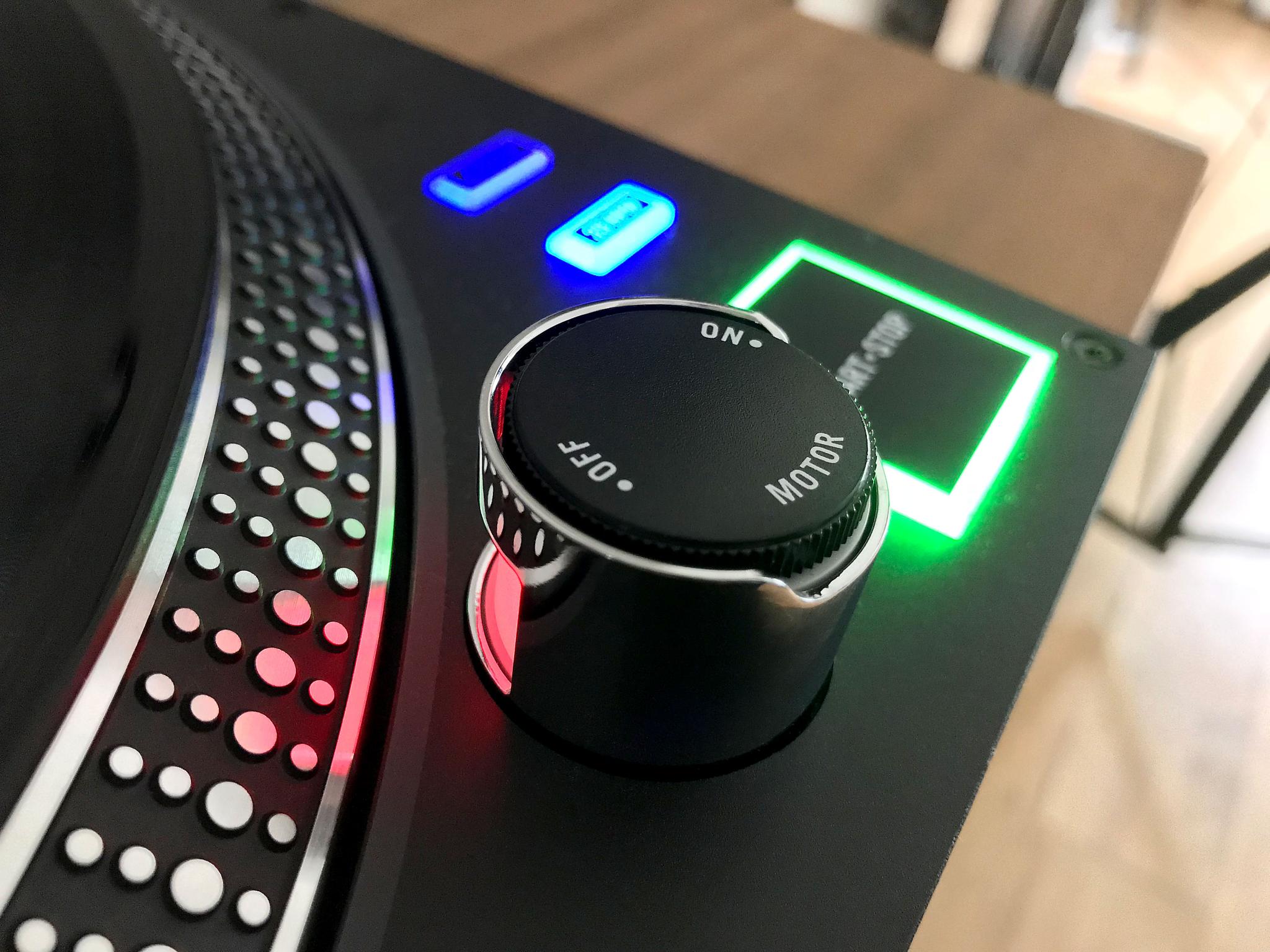
Side note — I cannot for the life of me work out how the power switch/strobe thingy has made it this far in turntable design. The very idea of combining a redundant strobe light (the stylus light can and does do the very same thing on other turntables) with a hard to operate rotating slider of a power switch, making it taller than it needs to be, and putting it right in the way of hand movement beggars belief. It is, to quote a famous speech, a monstrous carbuncle that needs to be excised from the face of every single turntable. Oh wait… the 1200 has it so it must be good. Silly me.

IT’S NOT JUST FEATURES
Apparently the new Reloop RP-7000MK2 is the best damned turntable in the market according to reviews. Indeed, looking at the specs, it has everything bar a straight arm and USB out that I might need. It is the most modern turntable with the best specs around.
So why oh why oh why must it slavishly look like an almost 40-year-old design? Is it a genuine belief that the design cannot be improved on? It is a genuine fear that trying to be anything but a homage to the 1200 is destined to fail? Yes it is a classic, but it’s a Technics classic. Reloop et al need to be brave and stamp their own identity on their products, and stop trying to be someone else.
To be clear – it’s not that turntables can’t do the task of playing records. For me, it’s the systematic devolving of features and utterly stagnant aesthetics that are my issue. I don’t want pointless features adding, but I do want those useful features that we have become comfortable with to remain, and ideally added to with some original and useful thinking.

The ethos of portablism
There is something very interesting about portablism. I’m talking about the modding culture of taking the standard portable turntable and doing more with it. This often means taking a Dremel to the unit, but when done properly, those cottage industry third-party products make their portables better and more than it was.
The Numark TTX hinted at the possibilities of this approach. In the box were straight and s-arm interchangeable tone arms. You could also swap around the locations of the pitch and speed controls. You could, to a degree, customise the TTX out of the box to suit your needs.
Perhaps an idea would be to make turntables with parts that can be easily interchanged. Essentially, provide a base unit that works to a reasonable spec, but generate a third party market that — just like portablism — can provide higher spec parts like pitch faders, buttons, and tone arms, and let the user make the turntable they want.

AN OPEN CHALLENGE
Here’s an idea — the industry finds it all too easy to drop significant amounts of R&D money pumping out biennial iterations of controllers with minor updates, wrapped in suitably worded PR that gives your insecurities a beating, and makes your GAS reflex throw money at the screen. Instead, how about looking past the Hanpin/Yahorng super OEM models and sitting down with a blank canvas and designing a turntable that doesn’t remove features, doesn’t look exactly the same as a 1200, and importantly moves things forward with some fresh thinking and innovation. Hell I’ll even send the Moleskines and Rotrings to get it started.
For a while, turntable design pushed a significant distance away from the 1200 blueprint, and delivered genuinely useful features with paradigm challenging aesthetics. But now, the industry is reverting to type, with features being systematically taken away, industrial design becoming industrial-already-designed, and at the same time the customer is expected to pay more. Is it a bean-counting thing? Or just pure fear of doing something that is not a 1200? Where are the good people at Vestax when you need them? And Chris — it’s time to pull out the old sketch books and carry on what you started.

SPEAK UP
But it’s not just the industry that needs to pull their collective finger out — it’s you lot as well. It amazes me just how vocal people get when their existing expensive and still perfectly capable controller gets an update, but not quite the quantum leap in stuff that your GAS makes you believe you need. “EPIC FAIL — I need more than 12 channels and 8 band EQ and filters per band and effects per filter per band and 24 USB ports for me and everyone at the festivals I hope to get invited to play” or similar usually accompanies controller and mixer releases. So why don’t you get as mad a hell when new turntables short change you for real?
Bottom line — if the DJ industry can extract £1K every few years for a controller that becomes landfill in less than a decade, then they can damned well sit down and make us a modern turntable that we can hand down to our kids if we want. Don’t worry about the cost — if people will pay £1500-2000 for a single media player or controller that they know has a lifespan shorter than your average goldfish, then they’ll pay for a turntable that delivers on features, quality, and aesthetics, safe in the knowledge that it’ll be relevant long after they’ve spun their last floor filler, and said goldfish has been flushed down the loo.
Consider this me throwing down the gauntlet. Are you up to it industry? I know I am. And I have a lot of Moleskines and a shitload of pens too.




Man, turntables need to grow up. Granted, I don’t think throwing cue points and MIDI commands on them is the answer, necessarily, but there has to be something that can be added to make them better in the digital age. Like, have the platter send MIDI as well, so you can control software with timecode for different things… or to control MIDI while using real vinyl.
Or put MIDI feedback on it (like that LED ring) to show positional information from software.
Or make it look like something other than a black rectangle (shout out to the TTX here).
I dunno. part of me says that turntables are antiquated technology, vinyl is a waste of space and effort for a modern DJ, and that we should step away from such an antiquated medium for performance purposes (excluding the turntablists, of course).
The other part of me thinks that, at its core, spinning vinyl is the most pure form of DJing, with a simple mixer and just some records. Losing that completely would be a disservice to newer DJs, especially when it comes to conceptualizing how to DJ.
But DJing is changing. People thought it would happen quickly, but it’s taking its time. Maybe it is time for us to start pushing the medium in a major way beyond two decks and a mixer. What does that look like? I have no idea.
I’m saying MODULARITY is the key. And I’m saying this about a decade ago.
Nobody gives a f***,so I just keep saying things.
I just hope that it won’t have the Pioneer trademark on the world’s firs modular DJ unit….. ‘cous than we are f***ed.
There should be a basic 12 inch controller for cheap, and every additional parts should be expensive.
Moduls like:
MPC pads and their function keys
Moving platter
Tonearm
BIG dual screen (1 for the info, another for the label-art kind of browsing)
PC inside
Additional, really studio-grade DA cards (like RME, Focusrite, Apogee, Halo…..)
color E-Ink vinyls…..
And the motor could be integrated in the platter itself, co it could be a slim, really stable platter that can get really-cut-your-arms-off-torque, for the fraction of the weight and price of today’s motor.
But the wear and tear business model is the way they go, so it will never comes. :(
If companies spend the same amount of money on research/development like they do on marketing/PR we would already be a little further I think…
And even though traditionalists will hate it but might AR (augmented reality) be a solution here? A basic interface that let´s you put together your own setup and with some more knowledge even program your own tools. The Rasberry PI and the portablism scene show that there is enough expertise out there. The only thing I´d miss from this is the sensual feedback you get from touching your equipment but there might be a solution for that in the future… the tools with changable rubber-like “interfaces” already look very promising. And it would also need a lot less resources that end up on the landfill in the not so distant future anyway…
R&D doesn’t have anywhere near the RoI that marketing does…
I think turntables have become this way based on some sort of “purism” ideology. The problem is, purism as we know it is dead, with even DMC allowing the use of timecode. Vinyl DJs by and large are using some sort of modern technology, whether it’s DVS, cue point controllers, or even at the very least a mixer with a powerful effects section. I suppose that there are still DJs out there who just use a basic mixer and strictly pure vinyl, but that’s not the market on the whole. And by the way, why didn’t you mention the CDT-05 in this article? Just kidding :-D
The CDT-05 is an interesting counter-argument to this. For those that don’t remember, the Gemini CDT-05 was an excellent hybrid turntable, that could play CD and vinyl. It had a removable tonearm, essentially making it into a Rane Twelve a full decade before the Rane Twelve. My review is here: http://www.skratchworx.com/reviews/cdt-05.php
But here’s the thing — despite pushing boundaries and delivering exactly what people had been shouting for, the various hybrid turntable options flopped. I bloody loved mine, and hated having to send it back. But maybe the truth is that people don’t want turntables to do more. Perhaps the market has spoken, and all they really want is an updated 1200alike. That makes me sad — I yearn for the TTX2 to appear and build upon what it started. Perhaps the Twelve.one or whatever the followup will be might be that turntable I long for.
Yep, this. It was a huge flop, as was the X2. Sometimes being first to market doesn’t mean shit – if the market isn’t ready to accept it, then it’s as good as useless
The X2 was such a cool device, and it even came at a great price.
Whenever new technology arises, the purists start to whine (CDJs/DVS/sync buttons/digital pitch will be the end of DJing!)
So to me it sounds reasonable to not give them innovative products.
I’ll just have Kontrol X1s/D2s next to my Technics and enjoy a good amount of nextlevelness.
Plus, when some new technology arrives, I’ll just swap those controllers (vs a whole turntable) for something new.
All those came around the time everybody was switching to jogs thanks to the obcene money Pioneer spent on redirecting the masses. Technics had flopped on their digital attempt and DJs were ready to ditch crates for CD books.
the Rane Twelve is not a turntable, its a controller. The fact you still need a computer in order to play music is straight up ludacris.
Rane should put out a real turntable if they still care about the culture.
Rane twelve diy was proved ten years ago (and criticised as usual)
https://youtu.be/MAbJCSvKqgY
Lots of new improvements around this “path” had been done over the years but nobody gives a f##k until rane puts a label on it so the problem about turntables is purism/toyinism itself. NI D2 has the 90% of features that a turntable needs to be a modern instrument but again NI must discontinnued it due to few adoption (and closed garden approach).
Probably a standalone mpc turntable shaped (and controlled) could be a great product (casio xw right designed with motorized turntabled) to add to the regular “scratching device” but even Nurkai or Pioneer avoid that and implement those in separated devices, again due to user rejection…
The scratching standard is so high and regular users so poor that make it worthless from business standpoint so diy is the only way to go (Portablism as example). That’s it.
Another researching path could be new materials (carbon fiber, tytanium, …) to make things lighter but durable, etc… but don’t expect it from/to scratch heads. These are more than happy with technics and portablism.
Quote Andrew Shepard (Michael Douglas) from the movie The American President –
“You gather a group of middle-aged, middle-class, middle-income voters
who remember with longing an easier time, and you talk to them about
family and American values and character.”
Do you think if DJ’ing had come of age without the existence of turntables (pretend for a moment Edison never invented the stick in a groove technology) we’d be having this discussion? The way forward is FORWARD!!
The dumbing down you’re looking for is the use of DVS in relative positioning mode. New products like Phase show how easily people forgot about absolute positioning and actual vinyl ’emulation’, once they had a big jogwheel.
Phase has nothing to do with the point I’m making. It came along after the DJ industry started removing features. It appeared independently of what the manufacturers are doing to turntables.
Not at all, it’s directly relevant. In a turntable world dominated by DVS, it demonstrates that for the majority of DVS users that even the tonearm is not of interest. This is about the only totally unique feature of a vinyl turntable, but it’s neutered by relative positioning. The majority of users are seeking a “big jogwheel” with buttons; it’s only a prolonged nostalgia that has allowed this to exist in turntable form for a little longer.
Your jokey photoshop at the top of the page should have had the tonearm removed, not the buttons :)
Not really… analog scratching keep the tonearm still relevant.
Those other users directly ditched the turntable entirely and use Ableton or S8.
the tonearm is highly important wirhout it i wont buy a deck ever
the joy of playing vinyl without a computer is unbeatable
Turntablists have always belonged to a very niche market. That market, for the most part, is the only market left for DJ Turntables. It is a huge gamble to release anything with a cost over the $500 USD pricepoint. Lets not forget that Reloop still has a matching, lower cost version in the RP series without midi and entry level turntables.
it wasnt a gamble for Technics to release the new 1210s and 1200s because those turntables beat any hanpin decks hands down in quality.
although i like the new RP7000MK2s by Reloop it still looks like a Technics clone.
Are you writing this knowing full well someone is about to buck the trend of stagnant TT design? Maybe NI is going to enter the market with an outside-the-box media player?
Or maybe TT designs don’t need to change because DJing is about playing and manipulating audio (ok and video, and lighting and people’s emotions) and this is now done with more options than just a TT. I like that the tech 12 is like the Jordan 1. Change the materials and colour ways but it’ll still have the same solid design foundation.
NI? I want to see it happen but I expect it more from Pioneer, sincerely…
Before looking at the future of turntables, I strongly suggest to anybody interested in this topic to open up and have a look at the insides of a Technics 1200 mk2.
I just spent my weekend refurbishing 3 beaten up 1200s, and to successfully do that I literally had to break them down in pieces, like every single section of them (tonerarm, motor, buttons, everything). Judging by the engineering I saw and the ideas those engineers had in order to make certain things work (like the on/off switch and it’s ball bearing mechanism), I can only say one thing: they were fucking analog geniuses!
This thing was engineered to absolute perfection. This can only be understood when its opened up.
So, why change it?
Vestax tried that and even though they delivered an absolutely amazing performance TT, fixing it is a nightmare. Numark tried it also, with a different approach, but those TTXs motors break down like shit. Then Hanpin happened and whatever.
35 years later and the 1200 is still the best engineered example of a TT available. I know this is a strong statement, but you will be surprised by how easy this TT is to upgrade/mod, based exactly on that original engineering that took place.
So, if you want the perfect TT, mod one. The portablism example showed exactly that. We have long rested our demands on companies, instead of working them by ourselves.
You want a lighter 1200? Check. Remove and substitute the internal dumping housing with a rubber one. Or even substitute the bottom panel with some lighter material. 3D printers are all about that.
You want a wider pitch range? Check. There are solution already available.
You want better sound? Check. Upgrade the tonearm wiring.
You want buttons/MIDI? Check. Drill some holes and start putting stuff inside.
You want the on/off switch gone/moved? Check. You can either mod it or move it somewhere else (where it can fit).
The only part which cannot be upgraded/modded is the motor itself (for more torque). Still, I wouldn’t touch the most amazing feature of that TT, its rock solid motor. And I’m still debating if more torque is actually necessary or not.
So, my suggestion is this: mods on the 1200, because it can actually handle it, without breaking down/deteriorating.
Truth. This is probably the reason behind no NI turntable never and the road to avoid also jogs (now maybe they will return to that) since the perfect jog is the turntable and the better turntable seems the 1200.
Actually you can up the torque. The mod here gets you about 2.5kg of torque.
https://www.lathetrolls.com/download/file.php?id=495&sid=8e601e22f805b7c8ab5006242698a739
It’s been reported that these mods actually wear off the lifetime of the motor. Now, question is how much can you actually “wear off” from such a good motor, but anyhow, its the only part I would never mod (this and the rotor mechanism inside the tonearm).
Anyone who says that it wears down the motor is straight up wrong. The mod is common for people who have record cutting operations with this and the higher end broadcast variants, who cannot have a thin go wrong. It’s a magnet. There are only bearings to wear down, and even then the wear that comes from that is based on play hours….which has been shown to be a non-issue. The only major issues that come from the mod are that you can actually get up to 3.0kg of torque but at that point pitch stability is shot to hell. The ceiling listed is based on the balance between higher torque and maintaining pitch stability.
The problem I can see with such a mod is that we are already talking about a motor with average 10-15 years of use. So, when you apply that mod, you will do it on an already heavily used motor, so the remaining lifetime of it can wear off pretty faster than expected.
Though, this mod proves that we can even work with the torque too, one of the most “criticized” features of the mk2. I wouldn’t personally do it, cause I don’t need it, but nonetheless somebody else could.
Yea….I’ve never felt that torque is the thing that is lacking but others do. This mod is one of those things though where fear of burning out the motor is the last thing that one should fear. The actual magnet/coil part will basically last forever. It’s copper and a magnet. Any wear is based on time running and cannot be damaged by this. One could worry about component failure on the motor control, but the chances of that are almost nothing. And the good part is that the board itself is so freaking basic that any parts that could burn out would be replaceable in about 20 minutes.
The only reason I’m pushing the issue is that there are real issues that can come up if the torque is raised too much (pitch stability), but people should only worry about the issues that can come up, not the ones that won’t.
Agreed, the pitch instability could end up being a more serious problem with this mod, than wear. But still, most people these days play with 0 pitch on DVS, sync be damned. So still, if it can hold on 0 pitch (which I guess it does), then this mod can provide significant gains. But problems will kick in if its combined with ultra pitch and scratching at -20/-25%. There, things will get ugly pretty fast, and this is a serious drwaback for any serious turntablist switching from a PDX to a super-modded mk2.
In regards to wether more torque is necessary or not –
I feel its purely down to whatever your used to or possibly conditioned to. I was Technics for life until I brought my first PDX, nowadays when I do occasionally cut on a technics I instantly notice how much some of my techniques rely on high torque motors, Im sure if I spent more time on Technics I could dial my shit in and do the same stuff to a good level with less torque but now Ive had several years on high torque motors I have no desire to have less.
Standard/basic features of a modern deck I’d like to see –
Line & USB audio out
Option to buy either straight or S-arm
Easy access & decent sized start/brake controls
Separate Ultra Pitch POT – Super OEM solution to 50 +/- ultra pitch on one pitch fader is far to coarse
Jus these simple basic features alone on a modern deck would give us better options than whats currently on offer.
FFS if anything should be ditched its the oh so pointless 78 RPM option, seeing 78RPM marketed as a feature makes my shit itch, I guess it must be a free add on for super OEM decks. Seriously who uses 78RPM for anything other than maybe cleaning a record?
Before even reading this piece the MK2 stanton 150 immediately sprung to mind when seeing the article title…. practically everything that made the original a great table dismissed in pursuit of playing it safe, jus like the overwhelming majority of manufacturers. That said I totally get playing it safe on aesthetics, my favourite decks to cut on – PDX, Stanton, TTX all have an acquired visual taste but I gotta give respect for anyone trying to be different. For manufacturers to constantly over look the pro’s of what made those decks popular is infuriating to say the least.
The pendulum effect of whats on offer is hopefully at its most dull extreme vs of what was on offer around 2000 – 2010. Until the pendulum starts swinging back towards more forward thinking or at least a non dumbed down deck its hard to see why existing owners of turntables made 10 plus years ago would buy a modern released deck.
I miss Vestax :(
There’s of course things that could be improved on the PDX range – at times questionable manufacturing tolerance and terrible isolation…. but from scratch a dj perspective the PDX 2000 is still to this day a favourite.
Is it to much to ask that jus one manufacturer would look at what made the PDX range successful, adopt the positives and improve?
I have a pair of Reloop RP-8000 straights. What more do you want?
Maybe a split platter ( midi mode ) that plays 2 tracks. The inner and the outer. 4 deck turntablism might be different. I dont juggle because i just use 1 deck so maybe I cant know how it would be but you might be able to do new tricks. Juggle super quick on 1 deck. Scratch 2 sounds or juggle on 2 decks and manipulate some outer tones as well. On a 4 channel mixer or a 2 channel mixer that could add another 2 deck modular mixer. Either above like an sp1 or at the sides of the turntables.
Maybe add up/down transformer switches in between the up faders so you cut between the inner an the outer.
Sure?
https://youtu.be/eJFfnTkyj-g
Turntables are just for playing records. There might be few people out there who might need some MIDI controls, fancy look, digital outputs etc, but it is very niche market I suppose? (turntablists come to mind)
Besides, Technics had released their new line of decks, which I think are great in terms of specs and features.
Either new Technics GR or used MK5G would work just fine for me :)
Technology is so advanced these days, so when it comes to DJing or simply playing music there are hundreds of tools out there, for anyone willing to go beyond two decks and a mixer…I don’t see a point in investing in some fancy looking turntables, since that is already incorporated in most digital equipment anyway, but it is interesting to see some new models coming out from different manufacturers.
I’m not saying MIDI is the way forward. At least it’s an open option, as opposed to proprietary solutions which I hate more than anything.
2 turntables and a mixer may be perfect, but mixers change ALL the time. I mean, look at the market for DJ mixers and you will find a different solution for different needs. Changing the design of a turntable could mean many, many different things. It could be the shape, it could be the functionality ON the device, like just LED feedback, the position of the pitch fader.
You may not need MIDI buttons on your fender telecaster, but you surely have bought different pedals to change the sound. Or different strings, or different amps to change how YOU sound. And you can change the wood the guitar is made out of, or the type of pickups, etc. There are ways you can customize the sound, which is what you use the guitar for.
A turntable is not the same as a guitar or a piano. The analogy doesn’t work. A turntable recreates sounds that have been pressed to another medium. It can be used AS an instrument, but that is a fundamental break in the design of the product. Things can be done to the turntable to simplify this process, and make breaking the design easier. For example, the strobe could be taken away, and we could have a better that actually makes sense in a day and age where 50% pitch bend is an option.
Two turntables and a mixer are not perfect. They can be improved upon in a digital age.
The truth is 99.9% of working DJ’s that do this for a living just A-B mix. All we need is cue points, pitch faders, channel faders, EQ & maybe a cross fader and delay effect.
Everything else is for controllerists and hobbiests who rarely if ever gig. (Maybe on YouTube)
And big name DJ’s make up the 0.1% of working DJ’s.
Reality is we don’t need anything else.
So… let’s just pack it in then guys. All DJ companies should stop making gear, we should all stop learning new techniques, and there should be no progress whatsoever. Technology developed 40 years ago (editing from 50 years ago after some thought) is good enough, and nothing needs to change.
Come on, man. Are you for real? No one is saying that the technology needs to be drastically changed immediately and we all need to learn new tools. But what’s the harm in even incremental improvements? You don’t mention looping, or gain, or filters, or beat jumping, or scrubbing controls (seeking, etc.), or browse controls, or sampling, or auto-gain, or limiters, or any of the other number of minor software and hardware advancements that have made DJing more convenient, easier, and better. Hell, I rely on looping and beat jumping when I want to spin on more than two decks at a time, which some people do. (And yes, I spin out at gigs, in front of people, and run parties, and do things)
This isn’t about big name DJs, and those hobbyists can eventually become working DJs. Is two decks and a mixer enough for a lot? Sure. Hell, it’s probably enough for 90% of what a DJ does. But that doesn’t mean that extra 10% can’t make a difference. YOU only need two turntables and a mixer? Then rock on. Nobody wants to take that away from you. But I want something more, because I want to do more as a DJ. You’re not wrong, and I’m not wrong. I want progress in the technology to make DJing better and more fun and more expressive.
I think you have lost track of what this article is about. It’s about turntables. Not controllers, or looping or fx or beat jumping. I am saying that maybe turntables haven’t strayed far from the Technics model because it is perfect for what it needs to do which is play records.
We both deviated from what this article was about, though. I was trying to follow what looked like your train of thought.
I think the turntable can be improved upon by designing it differently, or adding minor features to improve its functionality in the modern landscape. I mentioned that I’m not sure what the best way to handle that is, and that MIDI commands aren’t necessarily the right solution.
You responded that “99.9% of working DJ’s that do this for a living just A-B mix. All we need is cue points, pitch faders, channel faders, EQ & maybe a cross fader and delay effect.”
So… that’s what I was responding to. Your statement was not specific to turntables, but to how people DJ. I took exception to that mindset.
My personal setup is 2x Reloop RP-8000ST turntables, NI Z2 mixer, NI D2, NI F1. So I understand having all the extras to DJ with. I just don’t expect my turntable to have to do everything because that is just ridiculous. You couldn’t fit anything else on the RP-8000’s even if you wanted to, so I’m not sure what everyone is complaining about. If you want all the bells and whistles buy these. If you don’t buy the 7000’s or equivalent. All levels of the turntable market are already covered.
But there is no way I would DJ with all that crap in a club because it would just clear the dancefloor. I use the in-house CDJs with an NI TA6 and a Midifighter Twister for cue points and track browsing. Or just straight USBs in the CDJs depending on the gig. People want to hear songs not DJs mashing up loops with fx.
Whereas my personal DJ setup is a Rane MP2015, two D2s, and either two CD decks or two turntables, depending on A) my mood, and B) my desire to use physical hardware.
I am, once again, not stating that turntables need to do anything. Once again, I don’t even know if changes need to be made. But to state that turntables can’t be improved at all just sounds silly to me. Like, is it an optimized design for performance? I don’t think so. Can it be optimized to work with modern technology? Of course. Like, I’d love to have an LED readout on track position, or beat progression, to get more information out of what’s going on, or a screen to supplement my computer so I can see phase and the whatnot. I’m not saying MIDI commands or looping is going to make turntables better. In fact, I don’t think they will. But that doesn’t mean turntables are perfect, especially in a modern era. That’s literally my only point.
Nothing will display the information better than a laptop screen anyway. Cramming all that info on a small screen like a CDJ is a step backwards to me. Personally I mix with my ears more than my eyes. I am actually happy with where DJing is at technology wise.
I still use Neve mic pres and old mics in my recording studio. I believe somethings are perfect the way they are. I believe the same thing with DJ gear, sure there is always room for new ideas but that doesn’t mean that the Technics model isn’t a perfect piece of vintage gear like my Neve 1073 mic pre.
I don’t need all of the info crammed into a single screen. but supplementing in any way can be helpful. For example, being able to see a phase meter, or a waveform of what I’m touching, so I don’t need to look away from the gear, can be really useful. For example, I find mixing on my S8 or D2s to be SO much easier when I can see at least a brief overview of my currently playing music where my hands are, and I don’t have to go looking at two very different places. I don’t need to replace the laptop, but having the ability to focus my attention on one place while doing one thing is extremely helpful.
I don’t think the mic pre analogy is fair. How many changes have their been to the method of recording a human voice? You use a microphone, which is plugged into a chain or some sort, or an audio interface. Your pre-amp is going to sit between the mic and the computer, and the technology around it can change, while the pre is still useful. While you CAN spin the same way you did 20 or 30 years ago, you can DJ in very different ways now, and I think that this legacy technology can be brought into the modern era without impacting the classic ways of interacting. For example, putting a screen on a turntable doesn’t mean you need to use it.
Personally, I think the technics were perfect in their era (even though they did make changes over time), but I got into DJing in the early 2000s, and have approached it in a different way than you have. Neither of us are wrong, and I don’t want to take your method of DJing away. but I do think that turntables can be improved upon, and can be brought into a modern era where we can physically interact with our music (which I still believe turntables are the best for), and interface better with the computers we now mostly rely on.
Actually there have been many improvements in mic pres, well all Pro Audio gear. I used to run a Pro Audio/DJ department of a music retail store. So I know how superficial the incremental changes to gear really is as it was my job to sell it. Generally it is basically the same, packaged slightly differently or a reboot of an old idea for a new generation. Every sector of the music industry respects and loves their vintage gear or previous models for the individual things or sounds or look or ergonomics that makes that piece of gear unique. DJing is the only field that constantly complains about past and present gear like nothing is ever good enough and companies aren’t doing enough.
So, real talk, once we really got into a track of this conversation, this has been great. Off the bat, thanks for being respectful, and the best representation of the DJWORX community because, dude, sometimes the internet is awful.
I just want to be clear, I’m not complaining about turntables. I own turntables. I own a very simple set of turntables that have no crazy added features (STR8-150s), and I really like them. I think the TTX is a great example of the kind of progress I’m talking about. 1st, it didn’t try to look like a Technics. Second, I could move the pitch fader and readout based on the position of the turntable. And third, I could have an interchangeable tonearm. That’s a huge shift from what we have now.
And there’s nothing wrong with using Technics, or any other type of turntable. In fact, I’d still recommend many people buy used Technics 1200s for the sheer fact that they can be modified and fixed easier than most of the modern tools (which is a whole other conversation).
But once again, that’s not my point. My point isn’t about respecting the past, it’s about not mythologizing it. Because it was great at the time, and is still fine, doesn’t mean it can’t be improved. And the resistance to improve it is what frustrates me. And whether or not companies are doing enough is up for debate. The marketing, though, is 100% fictional. None of the turntable stuff is cutting edge or ground breaking, and that’s where a huge part of the frustration comes in.
I agree the TTX are great, but I don’t agree that there is a resistance to turntables moving forward. I own RP-8000ST’s that’s the model with the straight tone arm (because you can choose between straight or S tone arm). It has play/stop on both sides like the TTX. It has track browsing and track selection built into it. It has cue points, looping, sample/remix deck launching, fx and custom banks for midi mapping anything you want built in. And it has more torque than the Technics ever had.
It doesn’t have a light ring surrounding the record to show you track position like you suggested but that is what stickers on the record are for.
To me this sounds like worlds away from where turntables started from, so I can’t see the resistance to change you are speaking of?
I believe that turntables are moving forward the same as all other technologies. There will always be base and top models of all manufactured goods it doesn’t mean things are stagnant or going backwards, because that is just not true.
If Reloop were to bring out an updated 8000 or maybe a 9000, beyond minor cosmetic updates or microscopic increments in torque then I might agree with you. But given that Stanton and Denon brought out their top of the line turntables after the 8000 with less features but for more money, the evidence of retrograde development is incontrovertible.
When I think about it, I can’t imagine that a manufacturer would make a decision to remove things like 78. It makes no sense. So perhaps the factories are to blame. Maybe the brands are in the hands of the people manufacturing the turntables on their behalf.
But you can’t compare different companies and say it’s an overall trend. It’s like saying that the new BMW M5 has less features than last year’s Mercedes S Class, so there is retrograde development in the auto industry. Different brands do things differently for their own reasons you have to compare models within the same brand while is is owned by the same company over an extended period of time before you can make that conclusion.
The newest incarnation of the Stanton ST turntables has useful features removed, but the price remains the same. The VL12 Prime, a top tier turntable from the same people that brought us the magnificent TTX has had features removed, and the price increased. This is definitely a case of comparing apple with apples.
I genuinely hope I’m wrong, but the clear signs are there. And it needed calling out before turntable design becomes utterly stale. I refuse to believe that a piece of equipment so fundamental and core to DJing has peaked, and is indeed regressing.
Actually the Numark TTX was released way before Numark was bought by Uli Behringer and the VL12 Prime is the only turntable in Denon’s range, so the 2 aren’t even close to being comparable even though the companies are now currently both owed by Music Tribe.
Just to update your knowledge — Uli Behringer and Music Tribe don’t own Numark or Denon. It’s Jack O’ Donnell and his inMusic group that does. Jack bought Numark in 1992, and his key product guy Chris Roman has worked in both the TTX and the VL12, and is now the lead product guy for Rane, also owned by inMusic.
So there is clear continuity and lineage between the models I’m comparing, hence my disappointment that turntables since the TTX appear to struggle to reach that lofty height. I hope that helps clarify my position a little more.
I stand corrected I got In Music and Music Group mixed up in my head. I still believe you can’t compare Denon and Numark. The same way you can’t compare Volkswagen and Lamborghini or Audi with Bugatti even though they are all owned by the same company.
https://www.guitarcenter.com/Denon/VL12-Prime-Professional-DJ-Turntable.gc
https://www.guitarcenter.com/Numark/Numark-NTX1000-Professional-High-Torque-Direct-Drive-Turntable.gc
Remove the lights and feet, same table. The same people manage and design for both lines. Same engineers. Same shared resources. It isn’t an appropriate comparison,
The Lamborghini Gallardo and the Audi R8 share a lot of components as shown in the dual badging in the picture attached. They even share the same engine, the same engine that is also in the in the Lamborghini Huracan. I could go on listing different cars that share many components that are all owned by Volkswagen. I think the comparison is fair.
https://uploads.disquscdn.com/images/54f83e8ece3cfce4e01e344427b46d29ff87a394a11f1a23a764d1e894ed7289.jpg
You are speaking about your perception of the brand, which is completely different from what the brand managers aspire to be. Numark was and is seen as a premium brand by the people who work there, on the same level as Denon. You may look at it as a lesser brand, but that is on you, not on them. Your comparison doesn’t work at all, as it would be more like if you had VW and Audi were seen by the engineers as the same level of quality and customer, and you just thought that one sucked. Keep in mind that we actually know the people at these companies, and have had conversations about this very subject quite a lot. I’ve worked as a product manager for brands, and members of DJWORX staff have worked freelance for a lot of these brands as well. This isn’t coming from a place of opinion, it is fact.
You assume a lot I am actually a bit of a Numark fanboy. I have owned 2x V7s, NS6, NS7, NS7II, N4, 2x TTX, Carl Cox stylus’s, X7 customised in-house by Electric Factory for me because I am in-industry just like you. All brand managers think their brand is great, that is part of their job. The general perception is that Denon is a more prestigious brand than Numark by consumers and that is the opinion that matters in the real world.
Its not that I assume, its that you have told a lot about yourself, and in a lot of ways I was you (down to starting out managing the PA department at my local GC years back. And in this case, brand perception does not matter, because the point is that the design and build was made to a standard matching that of Denon (or at least Denon today). When something is made to have build and features matching the other brand then the public perception doesn’t matter, as the point is that they are supposed to be direct competitors (not lower). And as far as features not being needed (your original point), yes, I can do a lot with what is on a 1200, but here is the big elephant in the room-modern turntables aren’t 1200’s. Sure, the motor is good, great even, but they aren’t built to the same standard by a long shot. (I was hilariously enough soldering the phono board on my St.150m2’s last night even due to a weird ground issue that was fixed with a quick reflow) To really compete, manufacturers SHOULD be thinking about features, as, if you are making a table that is basically a 1200 copy, it isn’t a 1200 and is just that….a copy. And leaving off basic features like 78rpm on the Denon is even more absurd as it is limiting its use beyond DJ playback. The trend across the board is a downward feature trend (no doubt triggered by the success of the Pioneer, itself a success not because of its features but because of name), and that is just backward.
Brand perception always matters, it is the only currency a brand has and is the governing factor whether they succeed or fail.
Um…..Behringer does not own Numark or Denon…..
Wait… you have an MP2015? Did you know about this @happydan:disqus ?
All those things are easier to do in software. The physical spinning turntable is just an affectation that’s secondary to playing music. It became popular because it lets you physically manipulate the song is a very logical, immediate way. But it’s not inherently better than using buttons and a jog wheel. DJ turntables aren’t evolving because “evolution” discarded them long ago.
IDK why companies are stripping useful features from new turntables. I’d hazard a guess that most people buying them are hipsters, who will buy one and put it on their antique reclaimed vintage table to impress other hipsters.
Sorry, but isn’t that what Vinyl DJs want? They keep complaining about how everything that makes DJing even remotely easier and takes it further away from just “start a record, start a 2nd record, pitch it to the same speed as record 1 and move the fader”, isn’t #RealDJing anymore.
Leave the innovation to the DJs who actually appreciate innovation! If they still wanna use turntables, but also do some other things with it, they can add whatever extra equipment they need to their turntables.
Here’s an innovation, dvs by tone arm position, think about that.
I think it’s call absolute mode in Serato/Traktor/Rekordbox DJ.
But indeed, a controler equivalent of that, like the Rane Twelve with some sort of tone arm that can’t skip and don’t need needle, that would be great :)
Less is more.
You take Vestax as an exemple, but maybe that’s what company does too, and they don’t want to go bankrupt
Even if I agree on what you say, I know most of the DJ who use vinyl aren’t from the new generation, and they don’t want to have a turntable full of fonction they don’t use (or function they don’t know they could use). It use to be a culture open to technologies and innovation, but on the vinyl side, it took to much time to see some innovative product able to replace the Technics and so it give enough time to grow a nostalgic generation. And that’s probably the biggest part of the market.
On other hand, it’s good to see product like the RP 8000 who add some midi fonction without changing the design, and so it’s easier to be accepted. But yes, I agree, even if I’m from the old generation, I start mixing with shitty ETP turntable in the 90s and had enough money to buy real turntable when Vestax and Numark start to make quality stuff, so I switch from ETP to Numark TT2 (the pre TTX) without having the traditional Technics step (even if I use them at club and party). So I’m not nostalgic and I even prefer other brand because I like having a better torque in the motor, like Numark had (still have). But I’m not representative of a majority.
Kids (and digital DJ in general – even if DVS is digital, I don’t see them as in the same “philosophy”) wants CDJ like product, and that’s why most big controler are inspired by CDJs and other brand like Denon do their media player like the CDJ, but as it’s a new culture for the biggest part of the target, they can add new function, and add innovative stuff to seduce that part of the market (just like it was with mixer in the 90s, when this old generation was a new generation and still accept innovation). Unfotunatly it’s not the case for people who use vinyl (most of them), and even if people like you and me want to have a turntable with S9 fonction, a double start stop, ultra pitch, hid fonction with great motor torque and pretty led everywhere, is not the case of everyone.
I own a pair of RP 8000 and even with their sober design, when friends use them I have to set up the torque to be as close as a Technics (I have to do it, because they don’t know how of course…) and even like that (the torque to the minimum of course) they still complain like “oh the platter is not the same, the pitch is less precise”. But I know they’re not subbjective, I play with technics very often and I always have issue with the pitch when the power is not that stable (very common where I live). The only good thing that Technics have and not most of the new product is the isolation of the platter, but not very usefull in a DVS situation, as there is not rumble (I play with the Reloop with a set up put on bass box and no problem – even with enough vibration to cause bug with a friend’s hard drive – better use ssd for that..)
So for the future, I just hope product like the Twelve or Phase or the Numark NS7 will seduce a young generation and make moving platter a standard. Let’s hope PR do a great job for that :)
i want a turntable play with usb flashdrive no computer
I believe people complain to much. The reason for technology was to make it easy, inclusive and affordable. Example: Due to needle/stylus companies like Shure halting production on needles because of suppliers increasing costs on a niche product. You don’t have to worry about the demise of turntable-ism as the Rane Twelve now includes the new generation in the niche DJ industry and it cuts the cost of buying a new stylus.
The reason why companies like your Numark, Pioneer and many popular hardware companies are dumbing down hardware is because of the cost producing the hardware (hence why inMusic, the company that own Numark, Allen & Heath, Denon and M-Audio cut thousands of American jobs by moving their operations to China) and the cost of partsfrom suppliers to make the complete product (hence the Shure dilemma). When parts from suppliers are expensive, companies now have to scramble their heads on what to include in the next model, but when the whole hardware gets expensive to make versus the market cost. Companies discontinue with the product.
It is simple economic, you see it now with midi controllers replacing analogue DJ hardware and Let us all say thanks to Technics for uploading the sl1200 blueprints to the public domain or else everyone here who owns that beautiful motorized hardware would be singing a different tune.